

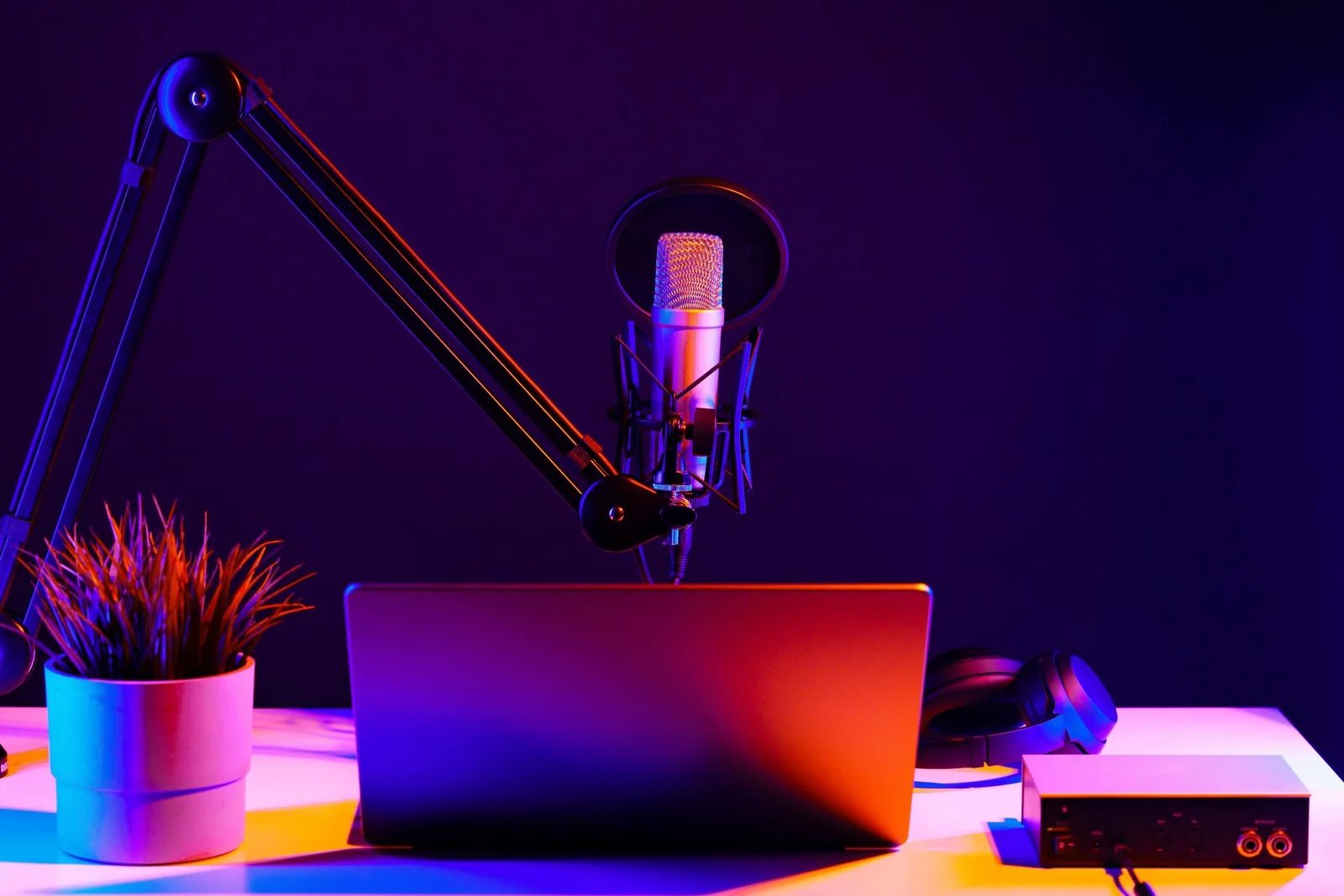
Most creators spend their energy trying to sound confident. They script more carefully, warm up their voice, practice delivery. What almost none of them consider is that the room they record in is already shaping their performance — before they say a word.
The environment you record in changes how you speak. It changes your pace, your pitch, your willingness to pause, your sense of authority in your own voice. And listeners pick up on the result whether or not they can identify its source.
This isn’t intuition. There is a body of research on how physical space shapes vocal performance, cognitive load, and perceived authority. Understanding it changes how you think about where you record — not just what you say when you do.
What the Research Actually Shows
Before getting into the mechanics, it helps to understand the evidence base — and where the commonly cited numbers actually come from.
Tone carries more communicative weight than most people realise. Albert Mehrabian’s research from the late 1960s is frequently cited to claim that 93% of communication is non-verbal — a figure that gets misapplied constantly. What Mehrabian’s studies (1967, 1971) actually found is more specific: when there is an inconsistency between what someone says and how they say it, listeners weight tone of voice at approximately 38% and the words themselves at 7% in resolving that inconsistency. The 55% attributed to body language applies to face-to-face situations only.
The relevant takeaway for audio recording: when your tone signals uncertainty, hesitation, or stress — regardless of what your words say — listeners resolve the conflict in favour of the tone. Your voice is doing more persuasion work than your script.
Environment measurably affects cognitive performance and vocal behaviour. Research in environmental psychology consistently shows that acoustic conditions shape how people perform cognitively and linguistically. Studies on reverberation and speech intelligibility (including work by Pica, Holliday and Morrish, 2006, and broader research on classroom acoustics) demonstrate that both speakers and listeners are affected by room acoustics — not just the recording quality. Speakers in high-reverb environments tend to speak faster, at higher pitch, and with less deliberate pacing. None of these are confidence signals.
Audio quality affects perceived speaker credibility. A study by Schwarz and Newman (2017) found that the same message delivered in lower audio quality was rated as less credible and the speaker as less intelligent, compared to the identical message in clean audio. The content was word-for-word identical. The listener’s judgment changed based on audio quality alone.
What Echo Does to Your Brain — Not Just Your Mic
Most creators understand that echo is bad for the recording. Fewer understand that echo is bad for the speaker.
When you record in an untreated space — a home office, a bedroom, a living room — your voice bounces off hard surfaces and returns to your ears a few milliseconds after you produce it. This creates a subtle but measurable auditory feedback loop. You hear yourself slightly delayed, slightly different from how you expected to sound.
The brain interprets this as acoustic instability and responds with increased self-monitoring. You start listening to yourself speak rather than focusing on what you’re saying. Self-monitoring mid-speech is cognitively expensive — it competes for the same attention resources as language production. The result is a performance that is measurably more hesitant: faster pacing, more filler words, shorter sentences, less willingness to pause.
The pause is worth focusing on. Confident speech is characterised by the willingness to hold silence. A speaker who pauses before an important point signals that they believe the point is worth waiting for. Untreated acoustic environments actively work against this — the discomfort of the space pushes speakers to fill silence rather than use it. Listeners interpret filled silence as uncertainty. Empty silence as authority.
In a treated acoustic space, the feedback loop disappears. You hear your voice clearly, without delay, without the room’s interference. The cognitive load of self-monitoring drops. Attention returns to the content. Speech slows, lowers in pitch, and becomes more deliberate — not because the speaker tries harder, but because the environment stops working against them.
The Psychology of Acoustic Space
Environmental psychology has documented for decades that physical space shapes behaviour and self-perception — a phenomenon sometimes called “behavioural setting theory” (Barker, 1968). The characteristics of a space prime certain kinds of behaviour and inhibit others.
A professional recording studio is a specific kind of behavioural setting. It signals seriousness, intentionality, and purpose. Entering that environment tends to prime a different kind of performance than sitting in a bedroom with a laptop.
This isn’t mystical. It’s the same mechanism by which people tend to sit differently in a formal meeting room than at a kitchen table, or speak differently on a stage than in a hallway. The setting communicates a set of expectations — and behaviour adjusts to match.
Creators who record regularly in professional studios consistently report a version of this: that they get into the content faster, stay in it longer, and feel less need to redo takes. The physical environment has already done a portion of the preparation work. The treated room, the professional microphone, the absence of domestic distractions — all of it signals to the speaker that this is a performance context. Performance contexts produce different vocal behaviour than casual ones.
What Listeners Actually Hear
Listeners are remarkably good at detecting confidence signals in speech — and remarkably bad at knowing that’s what they’re detecting.
Research in psycholinguistics identifies several prosodic features that listeners associate with authority and credibility: lower fundamental frequency (pitch), slower speech rate, longer pause duration, more consistent volume, and fewer disfluencies (filler words, false starts, repeated phrases). These are not arbitrary stylistic preferences. They track closely with the physiological and cognitive markers of low-stress, high-confidence speech production.
An untreated acoustic environment degrades most of these features simultaneously. Speech rate increases. Pauses shorten. Disfluencies increase. Volume becomes inconsistent as the speaker adjusts in response to their own echo. The listener’s brain registers the pattern and assigns it to the speaker — not the room.
This is the core problem. The audience doesn’t hear “bad acoustics.” They hear a person who sounds less certain, less in command, less worth listening to carefully. The room’s failings become the speaker’s failings in the listener’s perception.
Clean audio in a treated space doesn’t just remove the room’s interference. It removes the cognitive load on the speaker that the room was creating — and that cognitive relief produces a vocal performance that the listener experiences as authority, presence, and confidence.
How to Test Your Own Recording Space in 5 Minutes
Before your next session, run this sequence:
The clap test. Stand in the centre of your recording space and clap once, sharply. Listen for what follows. A clean clap with immediate silence means your space has good absorption. A clap followed by a rapid flutter or a decay that takes more than half a second means you have reflective surfaces creating echo. The more you hear after the clap, the more your microphone is capturing — and the more acoustic feedback your brain is processing as you speak.
The listen-back test. Record 60 seconds of yourself speaking normally in your space. Then listen back on headphones. Listen specifically for: any sense of the room in the recording (reverb, echo, boxy quality), any background hum (AC, fans, appliances), and the quality of your own speech — are your sentences shorter than usual? Are you filling more pauses than you would in conversation? Is your pace faster than you intended?
The environment audit. Walk around the space and identify:
- Hard parallel surfaces directly facing each other (walls, floors and ceilings without treatment) — these create flutter echo
- Any continuously running appliances — AC units, fans, refrigerators in adjacent rooms
- Windows without heavy curtains — glass is highly reflective and transmits street noise
- The distance from your mouth to the nearest hard surface directly behind or beside you
The benchmark comparison. Find a piece of audio from a speaker you consider authoritative in your field — someone whose podcast, video, or recording you find easy to listen to. Play it back-to-back with a recording of yourself. Listen not to the content but to the acoustic quality and the speech characteristics. Where is the gap? Is it the room? The pacing? The pause behaviour? The gap tells you what to work on.
What Changes When the Environment Is Right
The practical differences that creators report when moving from untreated home environments to professional recording spaces are consistent across types of content and styles of speaker:
Fewer retakes. The reduction in self-monitoring means fewer mid-sentence corrections, false starts, and abandoned lines. Takes that would require three or four attempts in a home environment often land on the first or second try in a treated space.
Better pacing without trying. Speakers who habitually rush in their home setups consistently report that their natural pace slows down in a studio environment — not through deliberate effort but because the acoustic stability removes the pressure to fill silence.
More willingness to pause. The pause is where authority lives. A speaker who isn’t fighting their own room is a speaker who can hold a pause without anxiety. That pause lands on the listener as confidence.
Stronger presence overall. “Presence” in audio terms is a specific thing — it refers to the sense that the speaker is close, immediate, and engaged. It is partly a function of microphone quality and placement. It is also partly a function of how the speaker sounds when they are not managing acoustic discomfort. Presence is what makes a listener feel spoken to rather than spoken at.
The Compounding Effect on Content Quality
The benefits of a professional recording environment don’t stop at the individual session. They compound across a content library.
A creator who consistently records in a treated space builds a body of content with consistent audio quality, consistent vocal performance, and consistent listener experience. Over time, listeners calibrate to that standard. The consistency itself becomes a trust signal — it communicates that the creator takes their work seriously and maintains a professional standard.
A creator recording at home introduces variable quality: the day the AC had to stay on because it was too hot, the session where traffic was loud, the recording where the room sounded noticeably worse than the one before. Listeners don’t consciously track these variations, but their aggregate experience of the content is shaped by them.
Consistency in audio production is the long-term equivalent of what treated acoustics provide in a single session: the removal of interference that allows the content and the speaker to be judged on their actual merits.
Record in a Space That Works With You, Not Against You
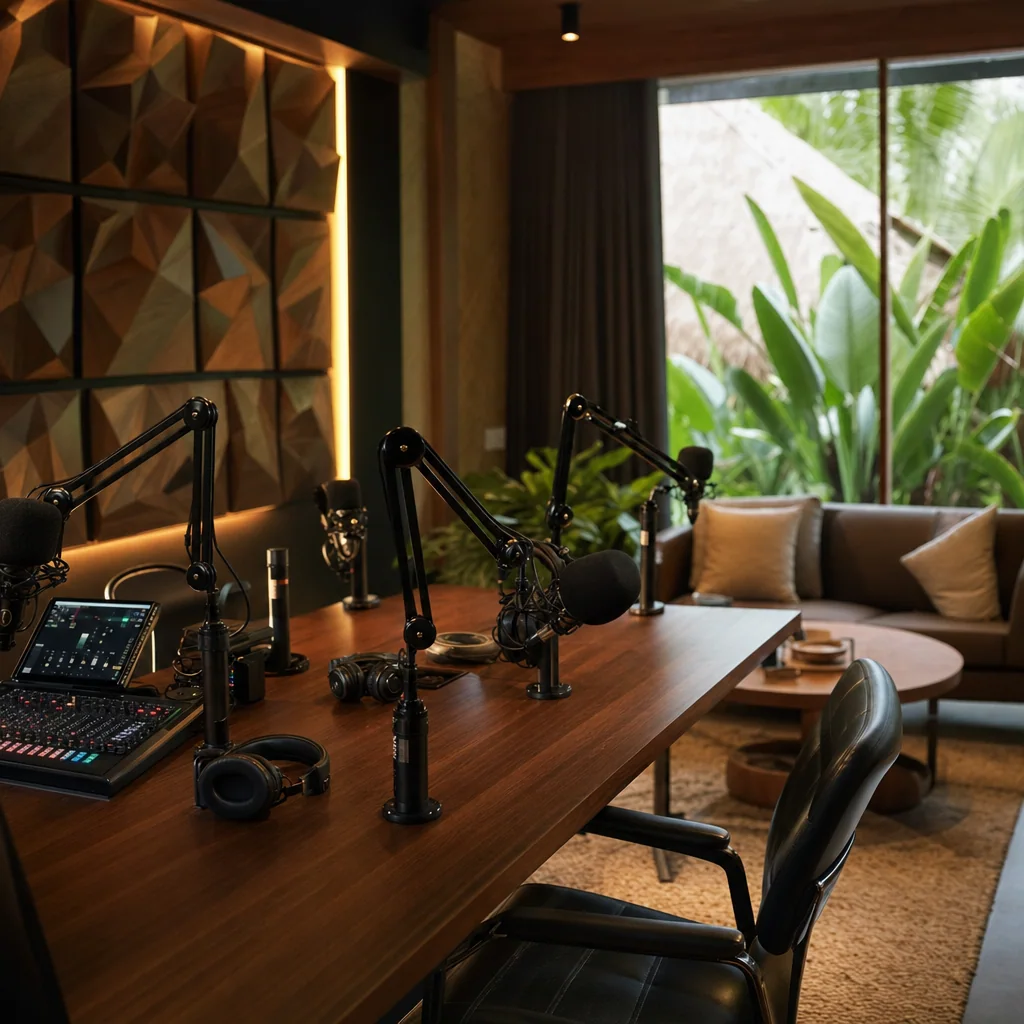
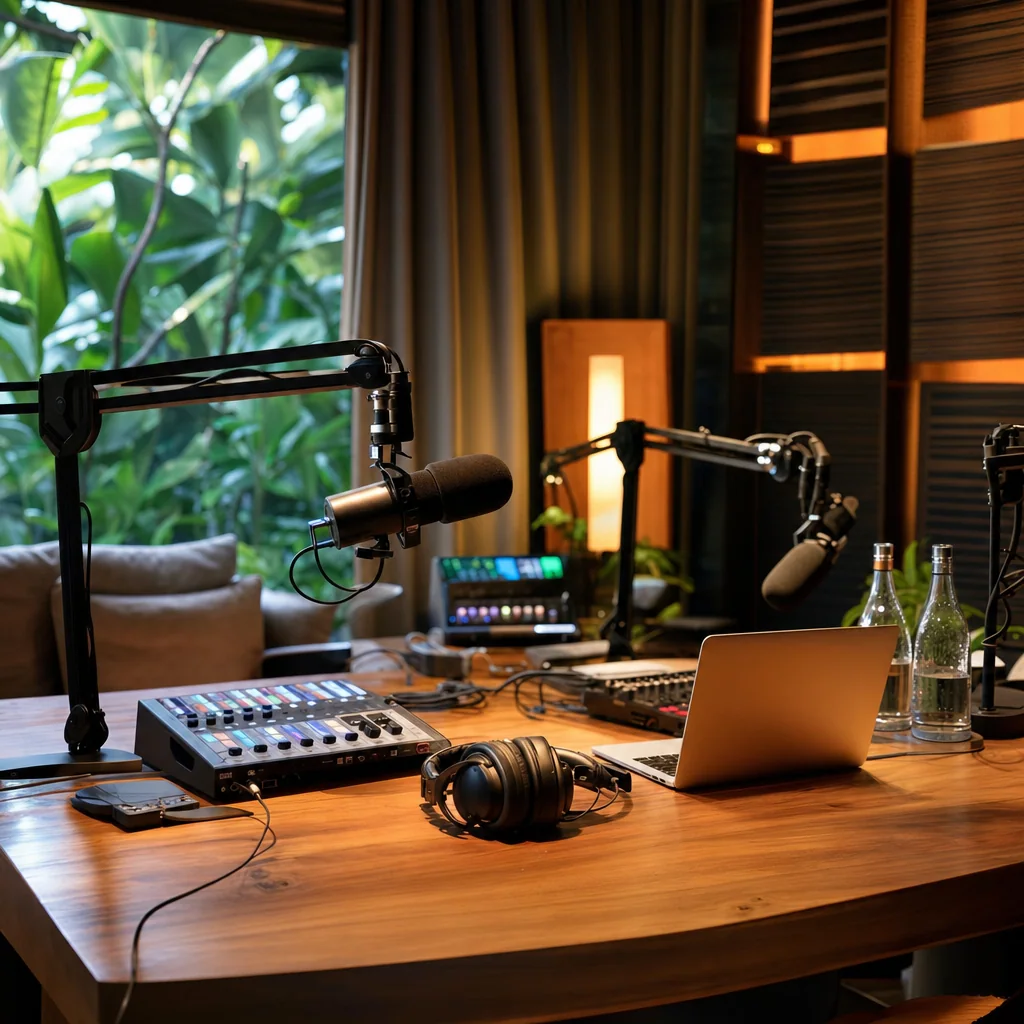
At Villo Studio in Canggu, Bali, our recording rooms are acoustically treated specifically to remove the interference that untreated spaces create — for the microphone and for you. The room is quiet, stable, and designed so that your only job when you sit down is the content.
Most creators who record with us consistently report fewer retakes, stronger takes, and content they feel better about — not because they prepared differently, but because the environment stopped working against them.
Visit villostudio.com to book a session or discuss a content production proposal.
Sources: Mehrabian, A. (1967). Decoding of inconsistent communications. Journal of Personality and Social Psychology; Mehrabian, A. & Ferris, S.R. (1967). Inference of attitudes from nonverbal communication in two channels. Journal of Consulting Psychology; Schwarz, N. & Newman, E. (2017). How Does the Gut Know Truth? Psychological distance, cognitive fluency, and the epistemics of intuition. Cited in broader credibility research; Barker, R.G. (1968). Ecological Psychology. Stanford University Press; Pica, T., Holliday, L. & Morrish, J. (2006). Research on classroom acoustics and speaker behaviour. Note: the 8-second authority judgment and 2x re-listen figures cited in email promotional materials are directional claims not drawn from a single verifiable study and are not cited here as research findings.