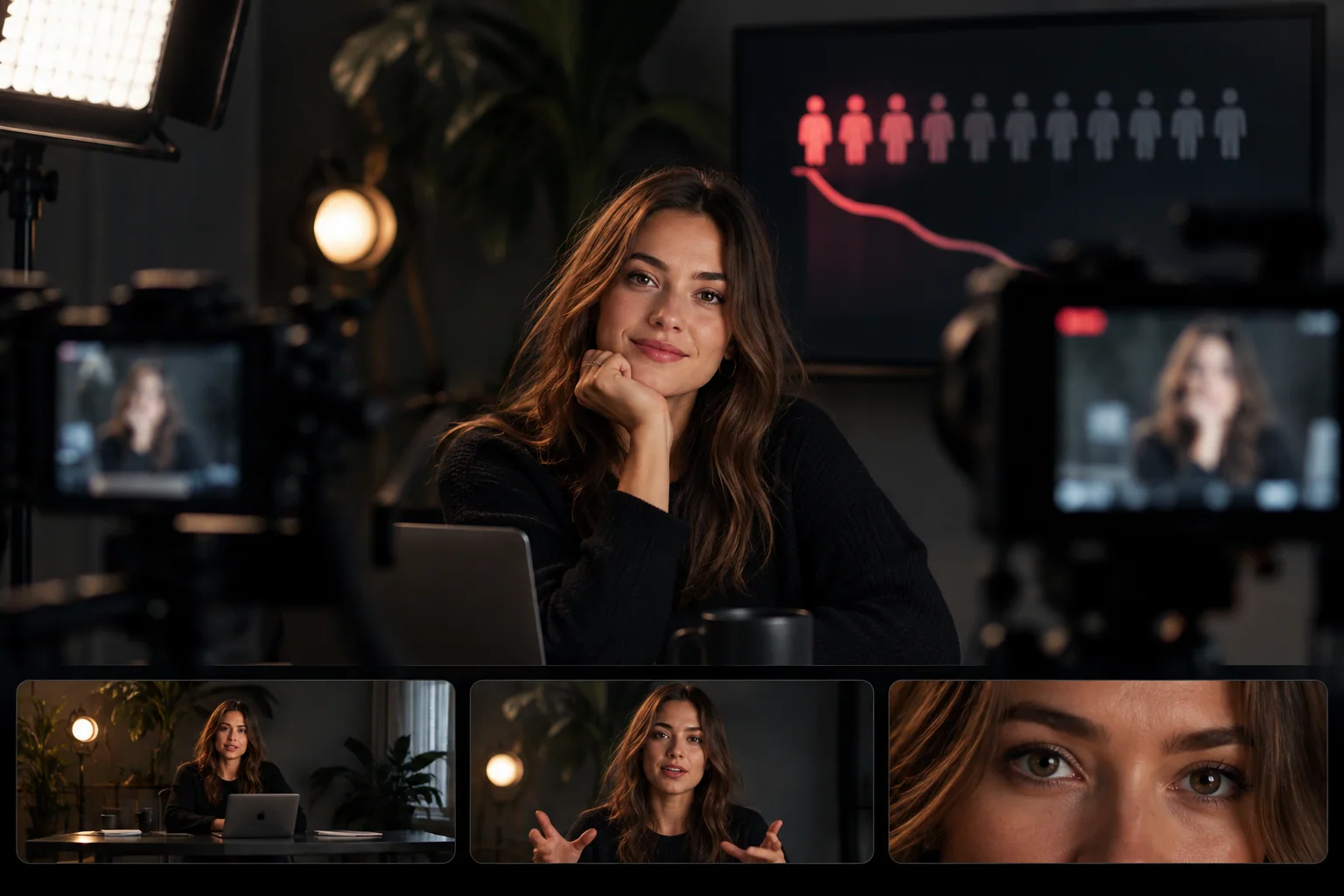



Most creators celebrate views. Few understand where those views actually go.
You hit post. The views climb. You reach 100. And then — nothing. No DMs. No bookings. No follows that stick. The number looked like progress. The outcome wasn’t.
This isn’t random. The drop-off from view to action follows a predictable funnel shape, and every stage of that funnel has a specific, fixable cause. Understanding the shape is what separates creators who optimise for views from those who optimise for outcomes.
The Funnel: What Happens to 100 Reel Views
Note: the 60/25/10/1 figures below are directional estimates based on observed platform behaviour patterns, not figures from a single cited study. Actual rates vary by account size, niche, content type, and audience. Treat them as a diagnostic shape, not precise benchmarks.
Of 100 people who see your Reel start playing:
~60 scroll past in under 3 seconds. They never gave it a real watch. The hook didn’t stop them. This is the largest single drop in the funnel — and it happens before your content has had any chance to land.
~25 watch some of it, then leave. They gave you a chance. Something in the middle lost them — a slow section, an edit that didn’t hold, a drop in audio quality, or structural drift where they couldn’t tell where the video was going.
~10 watch the whole thing. These are your real viewers. They processed your content. They’re the ones who might save it, share it, or want more.
~1 clicks your profile. Of everyone who watched, one person was curious enough to go further. That person is your actual conversion opportunity — everything else in the funnel feeds or starves this number.
The gap between 100 views and 1 profile click is not a platform problem. It is a content structure problem — and every stage has a specific fix.
What the Research Actually Shows
Independent of the funnel estimates above, these are verified findings about short-form video retention:
Early drop-off is the norm, not the exception. Wistia’s 2024 analysis of over 100 million video plays found that 33% of viewers stop watching after 30 seconds, with over 45% gone by the one-minute mark. For short-form content on mobile, the drop-off curve is steeper.
YouTube data confirms the first-minute problem. The Retention Rabbit YouTube Audience Retention Benchmark Report (2025) found that over 55% of viewers leave within the first 60 seconds. Poor visual and audio quality accelerates this curve.
Video drives purchase decisions at scale. Wyzowl’s State of Video Marketing report (2025) consistently finds that 87% of consumers say video has convinced them to buy a product or service. But production quality determines whether that video builds trust or breaks it before the message lands.
Credibility judgments happen before the content registers. Research from Princeton University (Willis and Todorov, Psychological Science, 2006) found that trust and competence assessments from visual cues form in as little as 100 milliseconds. This applies to the audio and visual quality of your recording environment — not just your face.
The combined implication: every percentage point of completion rate you recover has compounding value, because platforms use completion as a core distribution signal. Getting 12% completion instead of 10% on a piece of content isn’t a 2% improvement — it changes where the algorithm places your content entirely.
How to Fix Every Leak in the Funnel
The ~60 who left in 3 seconds: fix the hook
The opening frame has one job — stop the scroll. Most creators treat it as an introduction. That is the wrong instinct. An introduction assumes the viewer has already decided to watch. They haven’t.
Pattern interruption works: a text overlay that names a specific problem, a visual that breaks feed expectations, a first word that creates a question the viewer needs answered. Specificity outperforms generality at this stage — “how we turned a one-day shoot into 6 months of content” stops more people than “here’s what we do at our studio” because it creates a specific curiosity gap rather than asking the viewer to already care about you.
The test: watch your opening frame with the sound off. Would a stranger stop scrolling for it? If the honest answer is no, nothing downstream matters until this is fixed.
The ~25 who started but left: fix the edit
Mid-reel exit almost always traces back to one of three causes: a slow section that kills momentum, an edit that introduces visual or audio friction, or structural drift where the viewer can’t tell where the content is heading.
Cut every second that doesn’t serve the story forward. If a clip exists because it looks nice rather than because it moves the narrative, cut it. If a pause is there due to recording dead time rather than intentional rhythm, cut it.
Watch your Reel on mute first. If it looks boring without sound, audio is masking a visual pacing problem. Then listen with your eyes closed. Bad audio loses people faster than bad visuals — room echo, background hum, and inconsistent levels create cognitive friction that viewers don’t consciously identify but respond to by scrolling. You cannot fix captured noise in post-production. You can only prevent it before recording.
The ~10 who watched the whole thing: fix the structure
Completion rate is one of Instagram’s strongest distribution signals. A Reel that gets watched fully by 10% of viewers will be pushed further than one that gets 10x the views but 2% completion. This is the mechanism that makes short-form content compound over time — or not.
Full-watch retention isn’t primarily about length. It’s about structure. Give viewers a reason to stay until the end: a reveal set up early that pays off in the final frames, a framework where each point builds on the last, a before-and-after where the outcome isn’t shown until the end, or a punchline for entertainment-led content.
The common thread: the end has to mean something. If the last frame of your Reel is interchangeable with the middle, you have given viewers no structural reason not to leave early.
Getting saves and shares: make it worth keeping
Saves are a stronger signal than likes. They tell the algorithm the viewer found your content valuable enough to return to — a meaningfully higher-quality engagement than a passive double-tap.
Content that earns saves consistently has one thing in common: the viewer expects to need it again. Tutorials they will follow again. Frameworks they will want to reference. Behind-the-scenes that reveal a process. Dense quick-tip formats that don’t fully absorb in one viewing.
Aesthetic and inspirational content rarely earns saves unless it is highly specific to a strong personal context. “Beautiful Bali sunrise” gets likes. “3 camera angles that make any interview look cinematic” gets saves — and saves compound into further distribution via the algorithm’s explore and share mechanisms.
The ~1 profile click: fix where they land
Of 100 viewers, approximately one clicks through to your profile. That person is your most qualified lead from this piece of content. They watched. They were interested enough to want more. They navigated to find it.
What they find when they arrive either converts that interest or kills it.
A profile that converts has three things working together: a bio that communicates who you help and what they get — not just what you are; a pinned post that functions as a landing page; and a consistent visual feed that signals you are an established presence rather than an occasional poster.
The bio is the most neglected conversion point. Most bios describe the creator. A converting bio describes the visitor’s outcome. “Record your podcast in a professionally treated studio — walk in, sound like a pro” does persuasion work. “Podcast studio in Bali” is just a label.
The Metric That Actually Matters
Views measure reach. They don’t measure business outcomes.
The metric that matters depends on what you want the content to do. Bookings: profile visits that convert to DMs or booking page clicks. Audience growth: follows per 100 views. Content longevity: saves per 100 views. None of these are views.
The 60/25/10/1 shape is a diagnostic tool. When your content underperforms, it tells you which stage to fix:
- High views, low saves → hook is working, structure isn’t delivering value worth keeping
- Low views → hook or distribution is the problem
- High profile clicks, zero DMs → the profile itself is the leak
Fix in order. Hook first. Edit second. Structure third. Profile fourth. A broken hook makes every downstream improvement irrelevant.
Where Production Quality Enters the Funnel
Production quality is not a vanity concern. It affects the funnel at three distinct points.
At the hook stage, visual quality is part of the stop-scroll signal. For professional and B2B content, production standard sets the credibility floor before a single word is processed.
At the mid-reel stage, audio quality is the most common invisible exit trigger. Room echo, background hum, and inconsistent levels create cognitive friction viewers don’t consciously identify — but act on within seconds. The credibility research cited above (Willis and Todorov, 2006) applies to audio and visual environment quality, not just the speaker’s appearance.
At the profile stage, the visual consistency of your content library signals whether you are an established presence. A feed with consistent lighting, framing, and audio quality reads as intentional. Intentional reduces friction to booking.
Produce Content That Holds Up at Every Stage
At Villo Studio in Canggu, Bali, we produce podcast and video content for creators and brands who need production quality that works from the first frame. Acoustically treated rooms, professional lighting, 4K camera setups — and a crew that understands content strategy, not just equipment. Most sessions produce four to six finished pieces.
Visit villostudio.com to book a session or request a production proposal.
Sources: Wistia, 2024 video engagement analysis (100M+ video plays); Retention Rabbit YouTube Audience Retention Benchmark Report, 2025; Wyzowl State of Video Marketing, 2025; Willis & Todorov, Psychological Science, Princeton University, 2006. The 60/25/10/1 funnel model is a directional estimate, not a cited benchmark figure.