

Courses with professional video and audio see up to 2x higher completion rates than webcam recordings — yet most course creators still record in a spare bedroom with a ring light and a laptop mic. If you’re based in or passing through Southeast Asia, there’s a faster path: one studio day in Bali, with lighting, audio, and a teleprompter already set up.
We’ve run 1,138 sessions in 23 months from our Canggu studio. About 55% is talking head work — interviews, expert content, full course modules. We know what a smooth course recording day looks like. We know exactly where they fall apart. Here’s the playbook.
Why Bali Has Become a Real Hub for Course Creators
Indonesia’s digital economy hit $77 billion in gross merchandise value in 2022, and Bali — Canggu, Pererenan, Ubud — has absorbed a steady flow of creators, founders, and educators who run their businesses entirely online (Google, Temasek & Bain e-Conomy SEA Report, 2022).
The practical reasons aren’t romantic. Fibre internet in North Kuta runs 100–500 Mbps. Studio day rates sit at a fraction of London, Sydney, or Los Angeles. A two-bedroom villa with a pool costs less than a parking space in San Francisco. The creator-expat community here is dense enough that you can find an editor, a thumbnail designer, and a launch consultant within a 10-minute scooter ride.
The e-learning market was valued at roughly $399.3 billion in 2022 and is forecast to grow at 13.6% annually through 2030 (Grand View Research, 2023). Repeat bookings now make up 37% of our work. Four to seven course creators book sessions with us every month. That number has held steady for over a year.
What Is a Talking Head Video — and Why It Works for Online Courses
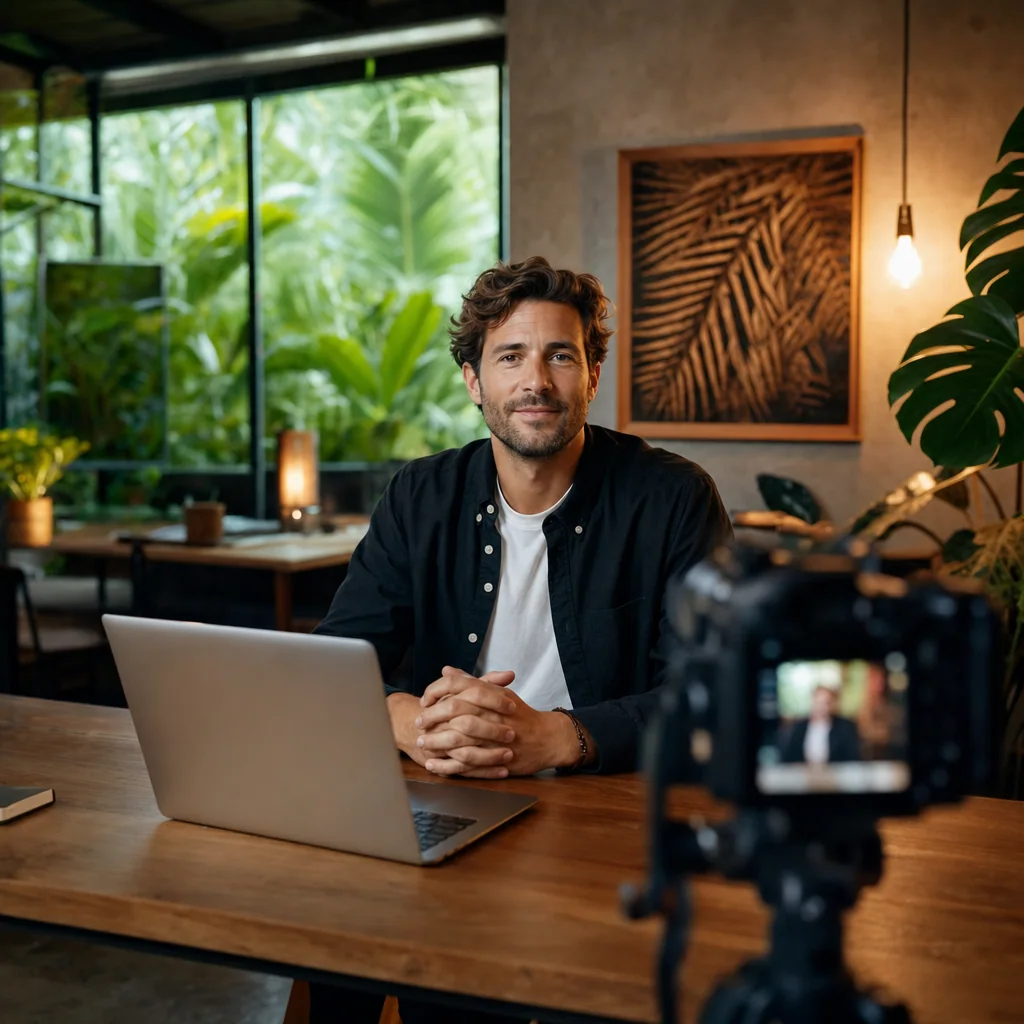
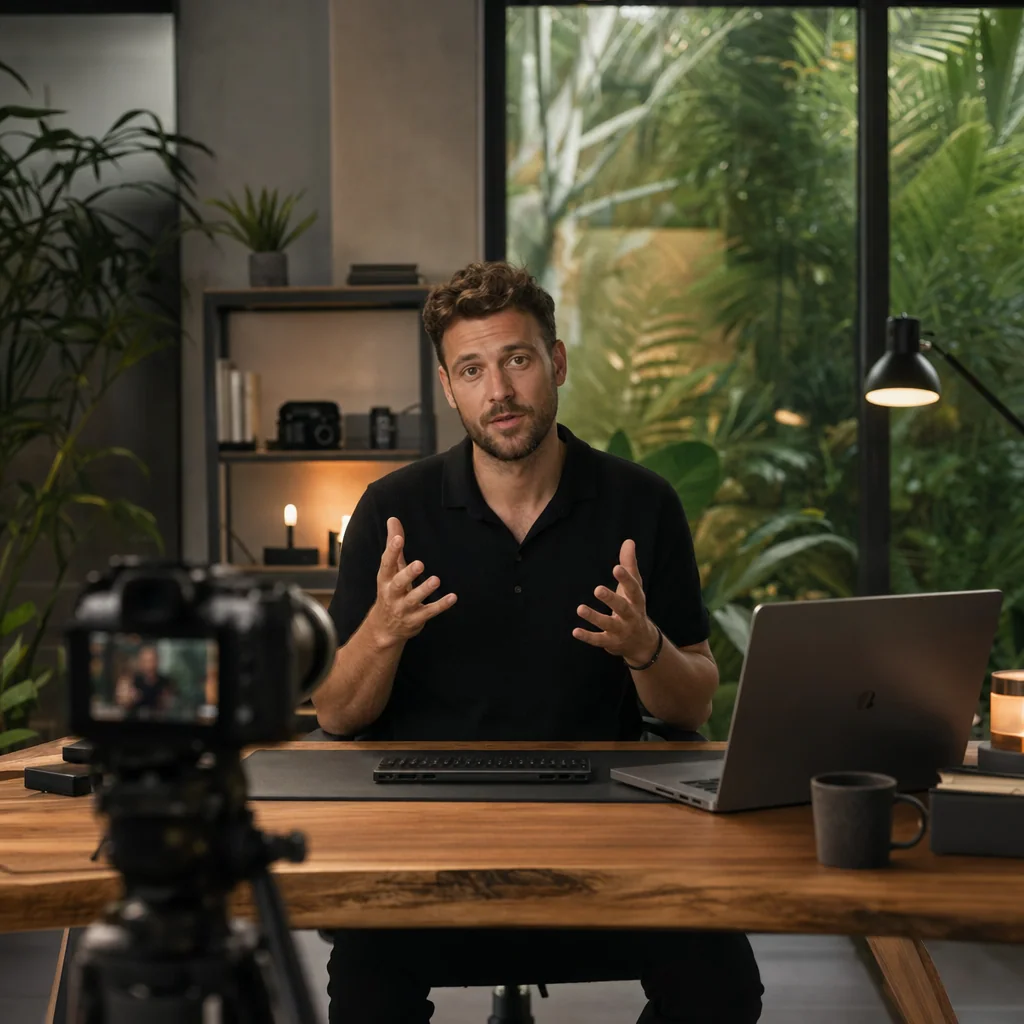
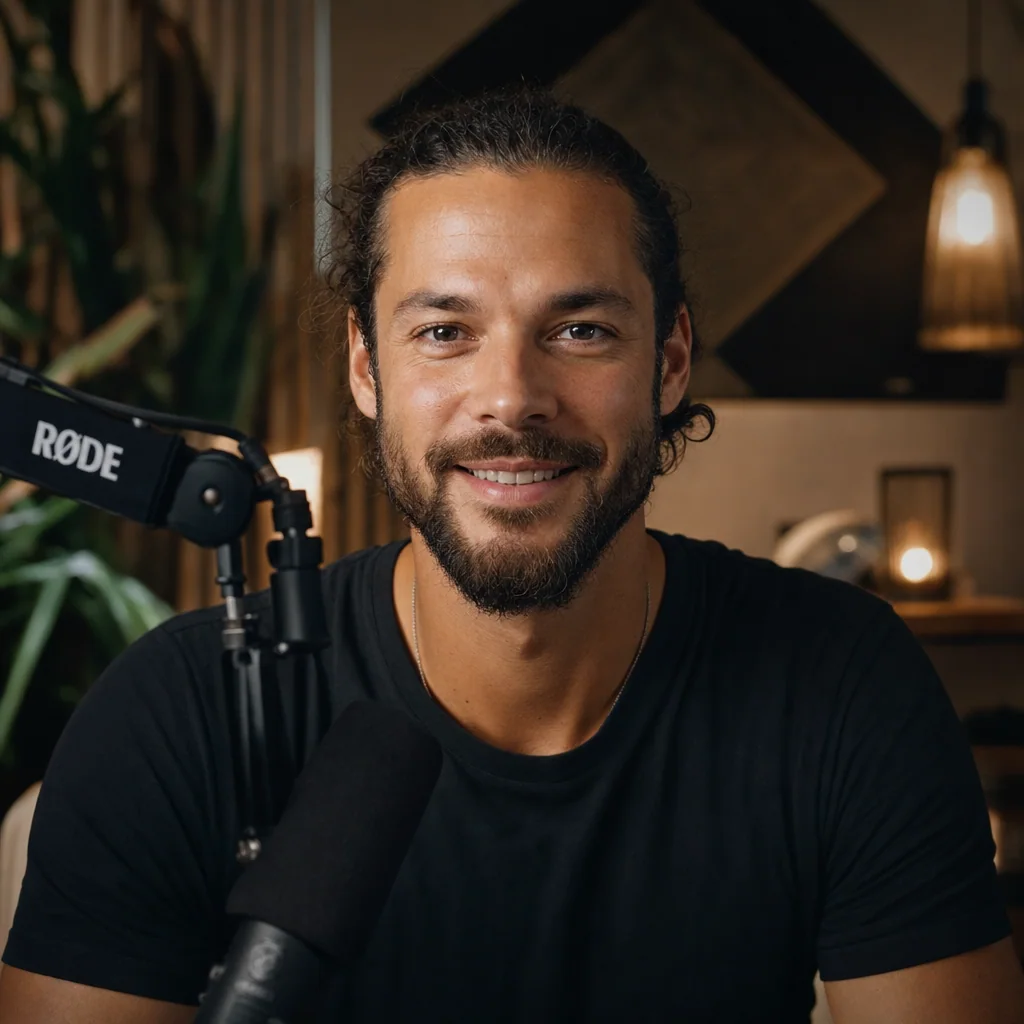
A talking head video is the simplest format in production: instructor speaks directly to camera. No B-roll cutaways. No animated overlays. One person, framed clean, explaining one idea at a time.
It works because screencasts can’t replicate it. When a student sees you, they form a parasocial connection — they recognise your face, your delivery rhythm, your eye contact. That recognition compounds across modules. By module four, they’re not learning from a slide deck. They’re learning from you.
Teachable’s 2022 industry report found that courses with professional video and audio quality saw up to 2x higher completion rates than courses recorded on phones or webcams. The mechanism is direct: when production quality drops, attention drops; when attention drops, students stop showing up for module five.
We’re sceptical of AI-avatar-led courses for anything beyond low-stakes evergreen content. Viewers feel the synthetic edge in the first eight seconds. In one client’s A/B test, real talking head outperformed AI avatar by 2.4x on first-module completion. The format is old. It still works.
What’s Included in a Studio Session at Villo
When you book a course recording day with us, you arrive, you perform, you leave with footage. Here’s what’s running in the room before you walk in.
Camera. Sony FX3 as primary, paired with a second or third FX3 or FX30 depending on the package. 4K, 10-bit, S-Log3 colour pipeline. Locked off on a sturdy tripod with framing pre-marked.
Lighting. Three-point setup using Aputure 600D and 300D Mark II as key and fill, with a LED rim light from behind. Diffusion through a 4×4 silk. Colour temperature locked at 5600K daylight. Your skin tone is dialled in before you sit down.
Audio. Shure SM7B on a boom for primary capture, Sennheiser EW lavalier as backup. Recorded to a separate audio interface at -16 LUFS broadcast standard. Wistia’s 2023 State of Video report flagged poor audio as the number one reason viewers abandon online video — ahead of poor visuals. We treat the microphone as the most important piece of gear in the room.
Teleprompter. A through-the-lens prompter with a 17-inch monitor. Load your script in advance or hand it to the operator on a USB stick when you arrive. The operator controls scroll speed based on your natural pace — you don’t manage it.
The operator. One crew member runs camera, prompter, and audio monitoring throughout the session. They’ll catch a misread before you do, flag a mic bump, and tell you when your hair has drifted out of frame. This is the single biggest difference between a smooth eight-hour day and a frustrating one.
Our talking head video studio in Bali page lists gear specs, room dimensions, and turnaround windows in detail.
The Multilingual Crew Advantage: English and Russian, Real-Time
Most studios on the island operate in English and Bahasa Indonesia. We run sessions in English, Russian, and Indonesian — often switching mid-day.
When your operator understands your script in real time, they catch what a non-fluent operator misses: a flubbed industry term, a sentence where you said “data” but the prompter said “deta,” a pause that’s too long because you skipped a comma. Uncaught, these moments force a re-record three days later.
50 of our 150 Google Maps reviews are in Russian. If you’re recording a Russian-language course for the CIS market, you’re not translating instructions to your crew. You’re talking shop. For English-language creators, the same principle applies — fluent crew flags phrasing issues and notices when your energy drops on module six.
Teleprompter Workflow: How to Arrive Script-Ready
Most creators either skip the teleprompter and forget half their script, or use one badly and look like someone reading a hostage statement. The fix is preparation, not talent.
Here’s the pre-production checklist we send every course client a week before their session.
1. Format your script in short lines. No more than 7–8 words per line. Long lines make your eyes track horizontally — the camera reads that as shifty. Short lines keep your gaze steady.
2. Write for speech, not the page. Read every sentence aloud as you write. If you stumble, your viewer will too. Contractions are your friend. Avoid clauses nested more than two deep.
3. Mark your breaks. Insert a line of asterisks or a clear visual gap between modules, sections, or B-roll points. This gives you and the operator a natural pause to reset.
4. Practice once at full pace. One read-through the night before. Not five. You want familiarity, not memorisation — memorisation flattens delivery.
5. Send the script 48 hours before the shoot. We load it into the prompter, format it correctly, and have a backup copy on a second screen. You arrive, sit down, and start.
A prepared script means fewer retakes. Fewer retakes means more modules per day. We’ve seen course creators record 8–12 modules of 10–15 minutes each in a single studio day when the script is ready. The same creators, unprepared, get through three.
Bali Studio vs. DIY Setup vs. Western Studio Rates
Here are the three options priced honestly. Figures are typical mid-market ranges in 2026.
DIY home setup (one-time cost). A mid-range mirrorless camera, two LED panels, an SM7B-equivalent mic, a prompter app on an iPad, and basic acoustic treatment runs $2,500–$4,000 to assemble. Add six to eight weekends of learning to light a room, mix audio, and edit before the footage looks usable.
Western studio rates (per day). A done-for-you course recording day in London, Sydney, or Los Angeles runs $1,200–$2,500, with editing billed separately at $80–$150 per hour.
Bali done-for-you (per day). Talking head packages at Villo start from Rp1.25M (~$75) for a 1-camera session and Rp1.65M (~$100) for our standard 3-camera setup. A full course day with operator, lighting, audio, and teleprompter lands at $300–$500 depending on session length and edit inclusion. Editing is a separate upsell at $135–$210 per finished video.
The online course platform market is projected to grow from $8.6 billion in 2022 to $35.2 billion by 2030 (Allied Market Research, 2023). If your course will sell for two to five years, production investment pays back across the entire revenue curve. Low production in year one doesn’t save money — it suppresses completion rates, which suppresses reviews, which suppresses conversions.
Ready to compare packages against your course scope? Book a course video studio session and we’ll send a quote within one business day.
FAQ: Recording Your Online Course in Bali
How much does it cost to record an online course in Bali?
Budget self-serve studios run $150–$400 per day. Full done-for-you packages with crew, lighting, audio, and teleprompter typically range $300–$800 per day depending on crew size, camera count, and whether editing is included. At Villo, talking head sessions start from Rp1.25M (~$75) for 1 camera and Rp1.65M (~$100) for 3 cameras.
What equipment do I need for a professional talking head video?
Core kit: a camera (mirrorless or cinema-grade), a three-point lighting setup with key, fill, and backlight, a directional mic or lavalier recorded to a dedicated interface, and a teleprompter for scripted delivery. A done-for-you studio includes all of this plus an operator to run it.
Is Bali a good place to record online courses?
Yes. Studio day rates are 40–70% lower than US, UK, or Australian equivalents. Fibre internet supports same-day cloud upload. The creator-expat community is large, and most production crews are fluent in English. Bali is now one of Southeast Asia’s largest digital nomad hubs.
How long does it take to record an online course?
A 5–10 module course can be recorded in 1–2 studio days if your script is prepared and you’re comfortable on camera. Editing turnaround adds 3–7 days depending on complexity. We deliver edited footage in 5 business days as standard.
What is a talking head video and why does it work for online courses?
A talking head is a direct-to-camera format where the instructor speaks naturally to the viewer. Students form a parasocial connection with a face and voice — which improves trust, perceived expertise, and module completion rates more reliably than screencasts alone.
How do I find a video production studio in Bali for course creation?
Search Google Maps for “video studio Bali” or “podcast studio Canggu.” Check Bali Expats and Canggu Community Facebook groups for recommendations. Prioritise studios that explicitly list “online course” or “course video” in their services — generic commercial studios often don’t carry a teleprompter or a course-style workflow.
Book Your Recording Day
If you’re planning a course launch in the next 90 days and want one focused studio day instead of six unfocused weekends, we have weekly slots open in Canggu. Record your online course with Villo — send us your module list and target shoot dates, and we’ll reply with a quote and a script-prep checklist within 24 hours.
Ready to record? Book our podcast & interview studio in Canggu, Bali — 4 microphones, 3 cameras, operator and lighting included. Walk in with a topic, walk out with a ready episode.