

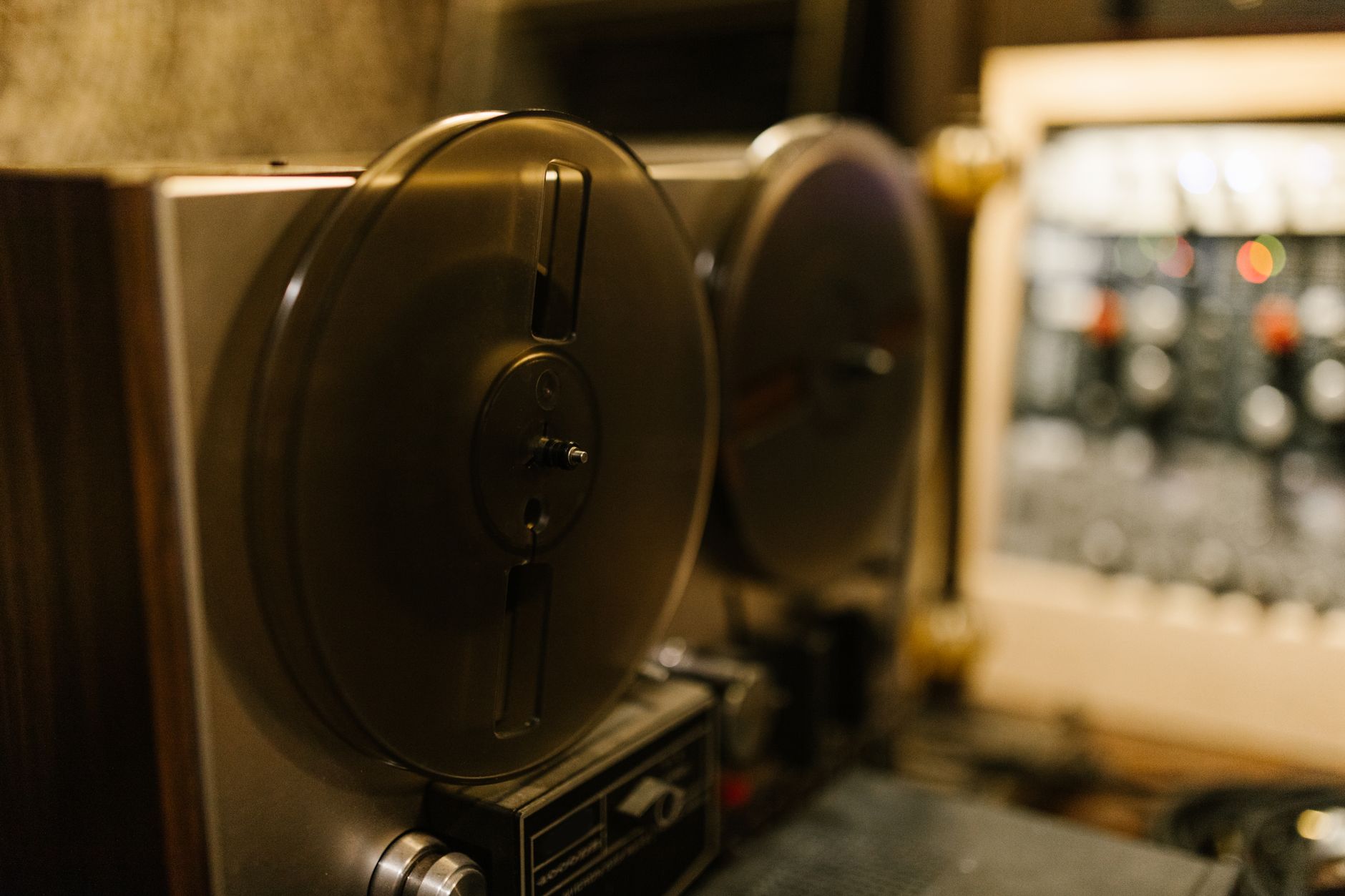
In 2025, the global podcast audience reached 584.1 million listeners, and according to talks.co's 2026 forecast, that figure will hit 619 million by 2026. Competing for that audience are 450,000 active shows out of 4.7 million registered podcasts. Background noise, wandering volume, and choppy edits can kill an episode in the first 30 seconds - regardless of content. Below are the technical standards and real-world pricing for podcast audio production.
What podcast audio production actually includes
Podcast audio production consists of four sequential stages: pre-production, recording, editing, and mastering - not just "editing." Pre-production locks down the room and the mic: acoustics, mic placement, capsule choice for the voice. Recording gives you the source file, and you can't pull out of it what isn't there. Musicians Institute (2026) describes this same structure in its breakdown of podcast audio engineering.
Editing and mastering solve different problems, and confusing the two gets expensive. Editing handles pacing: removing pauses, filler words, transitions, and episode length. Mastering handles the final sound - overall loudness, EQ, compression, and a consistent level between host and guest. If a contractor quotes a single line item called "editing" for $59, ask whether mastering is included.
A podcast producer is responsible for editing, mixing, mastering, show notes, and episode upload - the host is only responsible for the conversation. According to The Podcast Host (2026), shows hire a producer for exactly this set of tasks, not for "help with interviews." A three-line scope list saves two weeks of back-and-forth with a contractor.
A skipped stage always shows up in the listening numbers. Weak pre-production is an AC hum you can't remove later without a metallic artifact. Skipped editing is an episode that runs longer than its content justifies. Skipped mastering is a guest and host sitting at noticeably different volumes. Villo Studio in Bali has recorded plenty of podcast sessions. Clients most often come to us after they've already cut corners on that first stage.
What LUFS level does a podcast need
The industry loudness standard for podcasts is around -16 LUFS for stereo and -19 LUFS for mono. LUFS (loudness units full scale) measures perceived loudness rather than peak amplitude, so it reflects what the ear actually hears. At -16 LUFS, an episode sounds consistent across Spotify, Apple Podcasts, and YouTube: platforms normalize incoming audio on their own if a file is recorded significantly louder or quieter. Check your last episode with a LUFS meter before you argue with a contractor about quality.
Without LUFS normalization, a podcast sounds unprofessional even with a good recording - it's the main technical reason behind sound complaints. A typical pattern: the host at -14 LUFS, a remote guest at -23, and last episode of the same show at -12. The listener adjusts the volume three times in one episode and gives up on the fourth. Mastering brings every track and every episode to one target level - that's the work you're paying for separately.
LUFS is the only measurable characteristic of a podcast you can check before publishing. Tone and host charisma are debatable; a precise LUFS reading is not. Any free loudness meter gives you a number in a minute on a finished file. Make it an acceptance rule: when a contractor delivers an episode, measure the integrated LUFS first, then listen.
How much does professional podcast editing cost in 2026
Professional podcast editing costs anywhere from $50 to $5000 per episode - that's the range cited by Trevor O'Hare / Cleanvoice AI (2025-2026) for the 2025-2026 market. The hundredfold spread comes down to scope of work, not price gouging. $50 buys noise and pause cleanup on a single track for a solo show. $5000 buys a multi-camera episode with four tracks, music, sound design, and clip cutting.
Package pricing for podcast editing in 2026 breaks into three tiers according to PricingLink (2025): a basic tier from $59 per episode (noise cleanup, pause and filler removal), an extended tier at $139-199 (plus mixing and mastering), and a corporate tier at $349 (plus show notes, publishing, branded elements). Price scales with the number of stages from the first section, not with how "professional" the person doing it seems.
talks.co (2026) puts the global podcasting market at $34.3 billion in 2025, forecasting $42.6 billion by the end of 2026. US podcast ad spend will reach $2.55 billion in 2025 - up almost 12% year over year. A show built on an ad model can't afford to lose listeners in the first thirty seconds over volume issues. That's why a mastering budget stops being optional.
Package choice should depend on format, not on a "grow into it" budget. A solo 25-minute show released biweekly can live on the basic tier for years. Interview shows with a regular schedule and in-episode ads need mixing and mastering - otherwise you're paying $59 an episode and losing more on listener retention.
DIY editing or a studio - when to choose which
DIY editing makes sense at low volume: a solo show, one episode every two weeks, no guests, no ad reads. You're cutting one track, not mixing four, and the whole job comes down to noise cleanup, pause removal, and LUFS normalization. Starter tools are free, and the learning curve on a single track is a weekend or two. Start with the room and the mic: we've written guides on how to set up a home studio and essential gear to start a podcast.
Hiring an editor pays off the moment your hour of editing costs more than outsourcing it. An hour of recording typically needs three to four hours of editing with mixing and mastering. A founder with a high hourly rate spends three hours editing and still gets a worse episode than the $139 tier from someone who does this every day, per PricingLink (2025).
The second tipping point toward outsourcing is listener retention, not money. According to talks.co (2026), the US podcast ad market will hit $2.55 billion in 2025, and advertisers care about retention, not your attachment to Audacity. Split the four stages from the first section and outsource mastering while keeping editing in-house - you feel the pacing of the conversation better than a contractor does.
A third option is to outsource not the editing, but the recording itself. Clients come to Villo Studio in Bali with this logic: a source file with decent acoustics needs far less editing than one recorded in a living room with the AC running. A bad source file can't be fixed for $59 or for $349. It gets fixed by re-recording.
Recording a podcast with remote guests (double-ender)
A double-ender is a setup where each participant records their own track locally on their own device, and the video call is used only for communication. Final quality is set by the weakest participant's microphone, not by the call platform: a compressed Zoom stream delivers only what the channel can carry, and you can't recover detail that was never captured. A guest's local track never travels over the internet, so its quality equals the quality of their microphone. Agree on local recording before the call, not after you hear the result.
Track syncing is a standard step between recording and editing. Participants create a shared marker at the start - a clap, a spoken count, or a timecode. In editing, tracks are aligned to that marker, host and guest are cut independently, and mastering brings them to one level around -16 LUFS. Without separate tracks, you can't remove a guest's cough under your own line - it's not physically possible.
Not every double-ender participant needs a studio - one side is enough. The guest just needs a lav or USB mic and any local recorder, even a phone near their face. The difference between a laptop's built-in mic and a phone 20 cm away is audible without any meter. Send the guest three lines of instructions the day before: mic closer, record locally, send the file after the call.
Villo Studio in Bali regularly runs asymmetric sessions: the host records in Canggu with our equipment and an operator, while the guest joins from Moscow, Berlin, or Los Angeles and records their own track. Bali's UTC+8 lines up conveniently with US mornings and European evenings, so the window for recording with remote guests is wider than it looks. Check everyone's time zones ahead of time and pick a slot that works for the guest.
AI tools in podcast editing - what they can actually do
AI tools handle the mechanical part of editing and don't handle the editorial part. Noise reduction, pause and filler removal, transcription, rough cuts - here the algorithm is many times faster than a human and doesn't get tired by episode eight. Resonate Recordings (2026) describes exactly this combination of an AI pass plus human polish in its production process. The rough pass should always go to the algorithm - it's a matter of speed, not principle.
Decisions about pacing, tone, and cuts require context about the conversation that AI doesn't have. An algorithm doesn't know that a twenty-second pause before a guest's answer is the best moment in the episode, and it will cut it as "silence." It can't tell a slip that needs removing from one that a joke is built around. These are the decisions that determine whether a listener finishes the episode or leaves halfway through.
The working model for 2026 is AI on the rough pass, a human on the final check before publishing. The algorithm denoises, strips fillers, and builds a transcript; the editor restores the pauses that matter and sends the file to mastering at a target of around -16 LUFS. Villo Studio in Bali runs the same model: no episode goes to publication without a human listening through it start to finish.
Full podcast production at Villo Studio Bali
Villo Studio handles all four stages under one roof: pre-production, recording, editing, and mastering. The studio has operated in Canggu (Pererenan), North Kuta since June 2024. Podcast sessions are recorded on 2-4 cameras with a separate microphone and a separate audio track for each participant, for independent processing of host and guests.
One contractor covering the whole cycle removes the handoff problem: no need to separately find a studio, an editor, and a mastering engineer. A pipeline of three freelancers breaks exactly at the handoffs - the source file is in an inconvenient format, the editor doesn't know the target LUFS, the mastering engineer never heard the conversation.
Regular series are more cost-effective to book as a package. A package booking means a guaranteed slot, a single point of contact for the whole project, and consistent sound across every episode. If you're planning 10 or more episodes, talk to us about a package upfront instead of booking session by session.
More on clean audio technique: clean professional audio for podcasting and how to choose a podcast studio in Bali, if you're comparing a few locations.
FAQ
What does a podcast producer do?
A podcast producer handles editing, mixing, mastering, and often show notes and publishing. The host is only responsible for the conversation. According to The Podcast Host (2026), shows hire a producer specifically for this block of production work.
What does podcast audio production include?
Podcast audio production includes four stages: pre-production (room, mic, placement), recording, editing (pauses, fillers, pacing), and mastering (loudness, EQ, a consistent level). Musicians Institute (2026) describes this structure; skipping any stage shows up in the finished episode.
How much does professional podcast editing cost?
Professional editing costs $50 to $5000 per episode according to Trevor O'Hare / Cleanvoice AI (2025-2026). PricingLink (2025) package pricing gives a narrower benchmark: $59 for basic cleanup, $139-199 with mixing and mastering, $349 for a corporate tier with show notes and publishing.
What loudness level should a podcast have?
Target podcast loudness is around -16 LUFS for stereo and -19 LUFS for mono. At that level, an episode sounds consistent across Spotify, Apple Podcasts, and YouTube, and you can check it with any loudness meter in a minute.
Should you edit your own podcast or hire someone?
Editing it yourself makes sense while your hour is cheaper than outsourcing and the show is infrequent with no guests. Once an episode takes three to four hours of editing and the basic package costs $59 according to PricingLink (2025), it's worth outsourcing at least mixing and mastering.
Can AI replace a podcast editor?
AI doesn't replace a podcast editor, but it takes over the rough work: noise reduction, pause and filler removal, transcription. Decisions about pacing and cuts require conversational context, so a human still does the final check before publishing.
Record your podcast at Villo Studio
Villo Studio records podcasts in Canggu on 2-4 cameras with a separate audio track for each participant and handles editing, mixing, and mastering. Send us two numbers: how many episodes you're planning and how many people will be on camera - we'll set up the gear and slot around that. Book full production support at Villo Studio on the website.