

Booking studio time for a single video is like renting a commercial kitchen to bake one loaf of bread. The setup, the travel, and the mental gear-shifting eat up much of your energy before you've recorded a word. Treat every video as its own isolated production and you pay that overhead again and again.
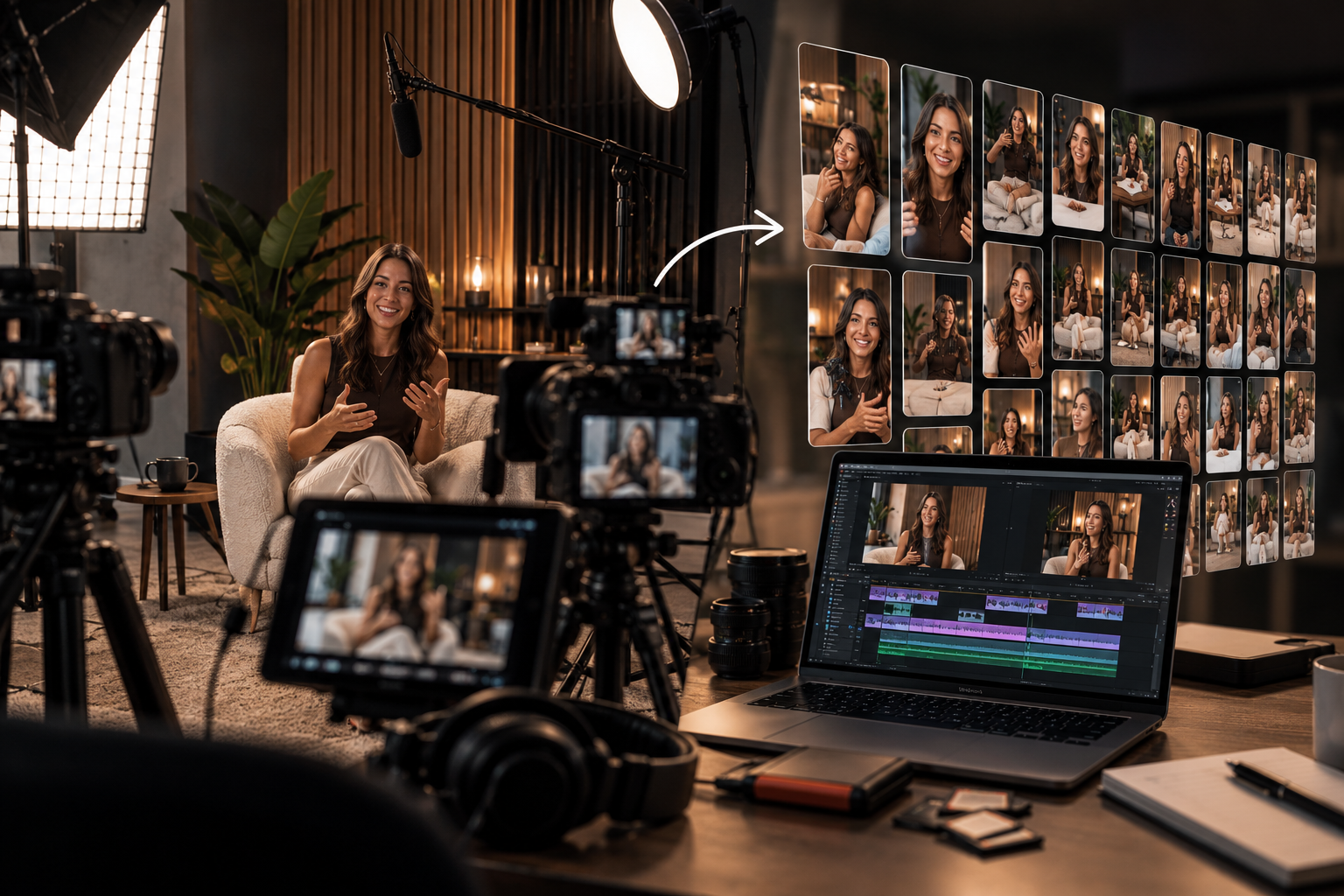
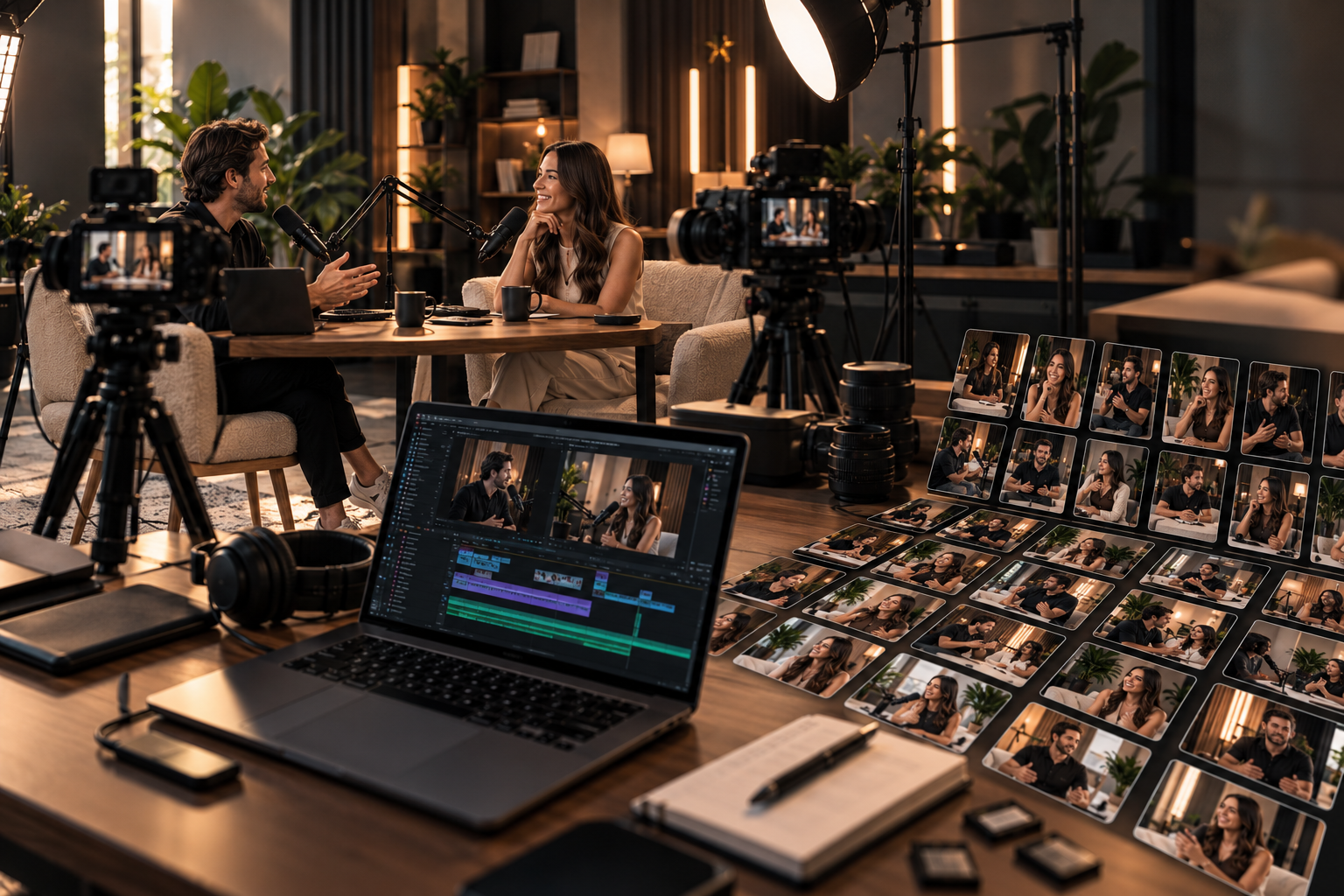
Batch production flips the logic. Instead of asking "how do I make this one video?", you ask "what can this one session produce?" When a shoot is designed from the start to yield multiple assets, a single 4-hour block can realistically become several long-form episodes, a stack of short clips, stills, and audio versions. The point isn't just more output. It's using the same fixed effort to produce far more.
1. The Unit Cost: Single Shoots vs. Batch Shoots
Every shoot carries overhead that has nothing to do with how good your content is: setup time, lighting and framing calibration, audio leveling, and getting yourself to the studio. The useful way to compare options is cost per published asset:
Cost per asset = (studio fee + setup and travel overhead) ÷ number of published assets
A simple illustration: say one session yields 1 episode and 4 clips, 5 assets in total. A batch session yields 4 episodes and 16 clips, 20 assets. You still pay the overhead once, but now it's spread across 20 assets instead of 5, so the overhead carried by each asset drops to a quarter. The exact savings in your own budget depend on your rates and output, but the logic holds: fixed costs get cheaper per asset as the number of assets grows.
2. How to Structure a 4-Hour Batch Session
A batch day works when it's planned like a production schedule, not an open-ended hangout. A workable shape:
| Time | Block |
|---|---|
| 0:00–0:30 | Setup, sound check, framing |
| 0:30–1:15 | Episode 1 |
| 1:15–1:25 | Reset: water, notes, wardrobe if needed |
| 1:25–2:10 | Episode 2 |
| 2:10–2:20 | Reset |
| 2:20–3:05 | Episode 3 |
| 3:05–3:15 | Reset |
| 3:15–4:00 | Episode 4 |
The short resets matter. They're where you change topic, swap a guest, or adjust wardrobe without letting fatigue creep in, which is the main risk of long recording days.
3. Design Content for Extraction
Short clips come out of long recordings far more easily when you plan for them. Before you record, decide on a few "clip hooks" per episode: a bold claim, a short story, a step-by-step tip, a counterintuitive take. When you reach one, deliver it as a self-contained thought with a clear start and end. Your editor can then lift it out as a standalone clip without needing the surrounding context.
4. Map the Month: A 30-Day Distribution Plan
Four core recordings can be spread across the month in different formats:
| Week | Long-form video | Audio | Short-form | Newsletter |
|---|---|---|---|---|
| 1 | Episode 1 | Podcast version | 4 vertical clips | Hook from episode 1 |
| 2 | Episode 2 | Podcast version | 4 vertical clips | Hook from episode 2 |
| 3 | Episode 3 | Podcast version | 4 vertical clips | Hook from episode 3 |
| 4 | Episode 4 | Podcast version | 4 vertical clips | Hook from episode 4 |
You record once and publish steadily, which is what keeps a content schedule consistent.
Practical Takeaway
Batching isn't only about producing more. It's about protecting your bandwidth while lowering the cost of staying consistent. One structured session replaces four scattered ones, and the rest of your month stays clear for the work you actually do.
Built for This Kind of Day
At Villo Studio in Canggu, Bali, we offer half-day and full-day batch shoot packages designed for exactly this workflow. You step into a pre-calibrated multi-camera set, our crew handles framing, switching, and sound, and you record your upcoming pipeline in one structured session.