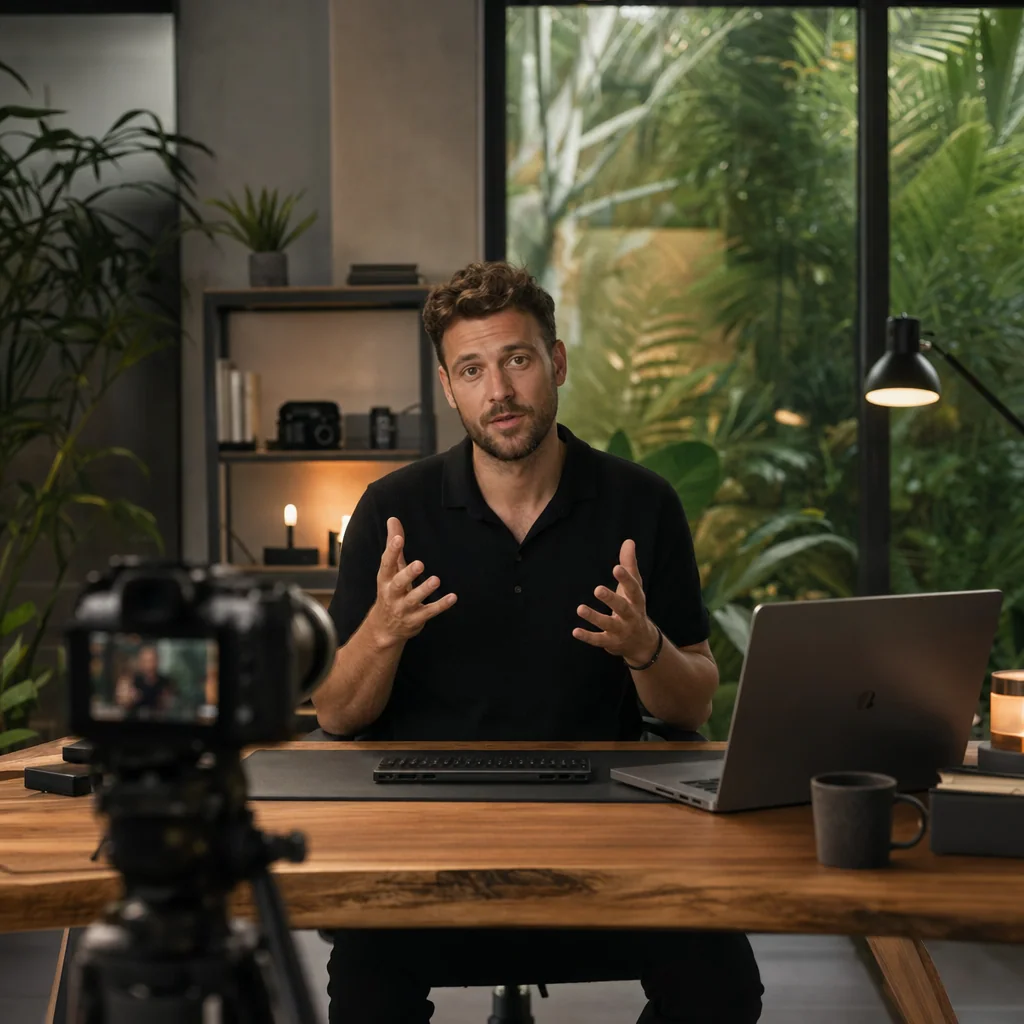


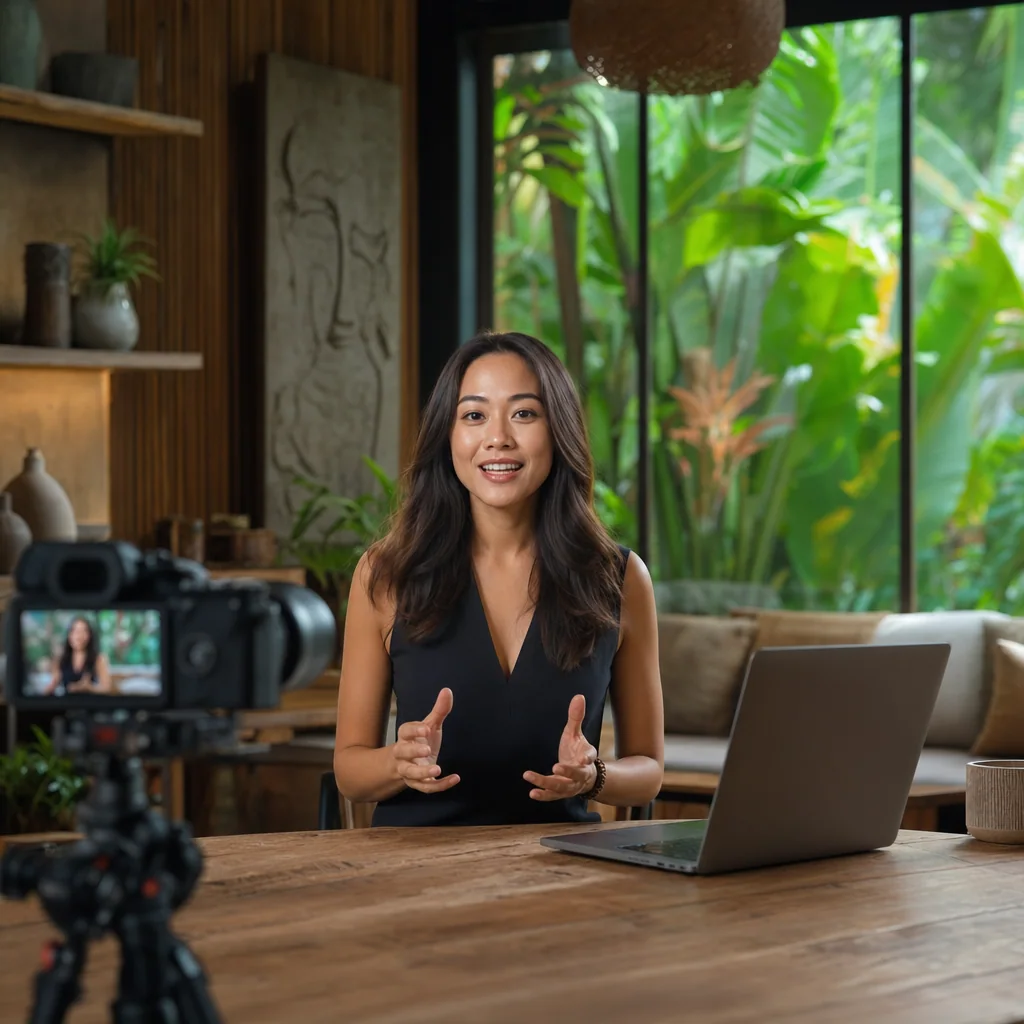
AI avatar videos are saving course creators thousands of hours — and quietly killing completion rates in some of the highest-ticket programs online. The technology works. The question is whether it works for your course, and most creators don’t ask that until after they’ve published 40 modules and watched their refund queue grow.
For a project built from your own footage, explore our AI avatar for online courses. Studio capture records your face, voice and gestures from IDR 1,600,000 per hour; training and the managed pipeline are quoted separately.
We’ve recorded 1,138 sessions in 23 months at our Canggu studio. A growing share are now custom AI avatar training shoots — founders filming once to deploy hundreds of videos later. The pattern is clear: avatars have a narrow sweet spot. Outside it, they cost more than they save.
What Is an AI Avatar Video?
An AI talking avatar is a video where a synthetic presenter delivers a script you type. You write the words, the avatar mouths them, finished video comes out the other end. No camera, no studio, no re-shoots when you fix a typo on slide 14.
The global AI avatar market was worth roughly $10 billion in 2023, with growth projected above 30% CAGR through 2030 (Grand View Research). Synthesia alone reports more than 50,000 businesses on its platform, including 44% of the Fortune 100. That adoption is being driven by one thing: scale.
The e-learning market is on track to hit $400 billion by 2026 (Global Market Insights). A 40-module course shot traditionally is roughly 40 studio days when you count re-shoots, wardrobe consistency, and script edits. An avatar version is one filming session and 40 script files.
Wide adoption doesn’t mean universal fit. Enterprises onboarding 10,000 employees into compliance training have different needs than a solo coach selling a $2,000 transformation program. The math that works for one breaks the other.
Where AI Avatar Videos Earn Their Place
Four content types where avatars consistently outperform — or at least match — traditionally shot video at a fraction of the cost.
Tutorial and skills-based content
Software walkthroughs, coding lessons, design tutorials. The value sits in the screen recording, the workflow, the demonstration. The presenter is a narrator, not the product. An avatar is invisible here — and that’s a compliment.
Compliance and onboarding modules
Anti-harassment training. GDPR primers. Safety protocols. These need to exist, get watched, and pass an audit. Nobody buys them for the instructor’s charisma. Enterprises figured this out first, which is why 44% of the Fortune 100 are already on Synthesia.
Multilingual scaling
Film once in English. Dub into Spanish, German, Indonesian, Japanese — same face, same brand presence, lip-sync that mostly tracks. Doing that with a human presenter means five separate shoots and five separate calendars. Avatars reduce that to one afternoon.
Evergreen content with frequent updates
Pricing changes. Tax law updates every January. If a one-line correction means re-entering a studio, you either ship outdated content or pay the re-shoot tax. Avatars let you swap a sentence in 10 minutes.
If your course sells the information, an AI avatar can deliver it. If your course sells you, it mostly can’t.
Where AI Avatar Videos Fall Flat
Most articles on this topic skip this section because they’re written by people selling avatar subscriptions. We won’t.
High-ticket coaching and transformation programs
A $3,000 leadership course isn’t sold on information density. It’s sold on the founder’s story, their authority, the parasocial connection a buyer builds watching the sales page. Replace that with a synthetic presenter and the program becomes interchangeable with a $99 alternative. Buyers feel that gap inside the first lesson.
Wellness, therapy-adjacent, and mental health content
Trust is the delivery mechanism. A meditation course narrated by an AI is uncomfortable in a way that’s hard to articulate but impossible to miss. Two founders booked real footage shoots at our studio specifically after testing avatars in this niche and watching completion rates collapse.
Courses where the personal story IS the product
If your sales page reads “I built this after escaping corporate burnout,” your buyer wants to see that person teach. An avatar version of you discussing your own divorce, your own bankruptcy, your own recovery — the dissonance is loud.
The learner trust problem
Students recognise AI avatars more often now than a year ago. Mismatched blinks, slightly off prosody, hands that never quite move right. Undisclosed avatar use in premium courses is triggering refund disputes and chargebacks. Most legal frameworks don’t require disclosure yet, but audience norms have moved faster than the law.
The Authenticity vs. Scale Trade-Off
Most solo creators think they face a binary: be on camera every week forever, or scale with a generic avatar and lose brand presence. The first burns the founder out by month four. The second turns a personal brand into a content farm.
There’s a third option — a custom AI avatar trained on your real likeness. You film one extended studio session, typically 4 to 6 hours of varied delivery, expressions, gestures, and lighting conditions. That footage trains a model on your specific face, your specific voice, your specific cadence.
From there, the workflow inverts. Script in, video out. Your face, your voice. The trust equity you’ve built doesn’t reset every time you publish.
The enterprise market uses avatars to remove the human face from the equation. Solo creators need the opposite — to preserve their face while removing the bottleneck of always being on camera. Wistia’s engagement benchmarks show on-screen human presenters drive up to a 38% lift in viewer retention over faceless video. That lift only applies if the face is actually yours.
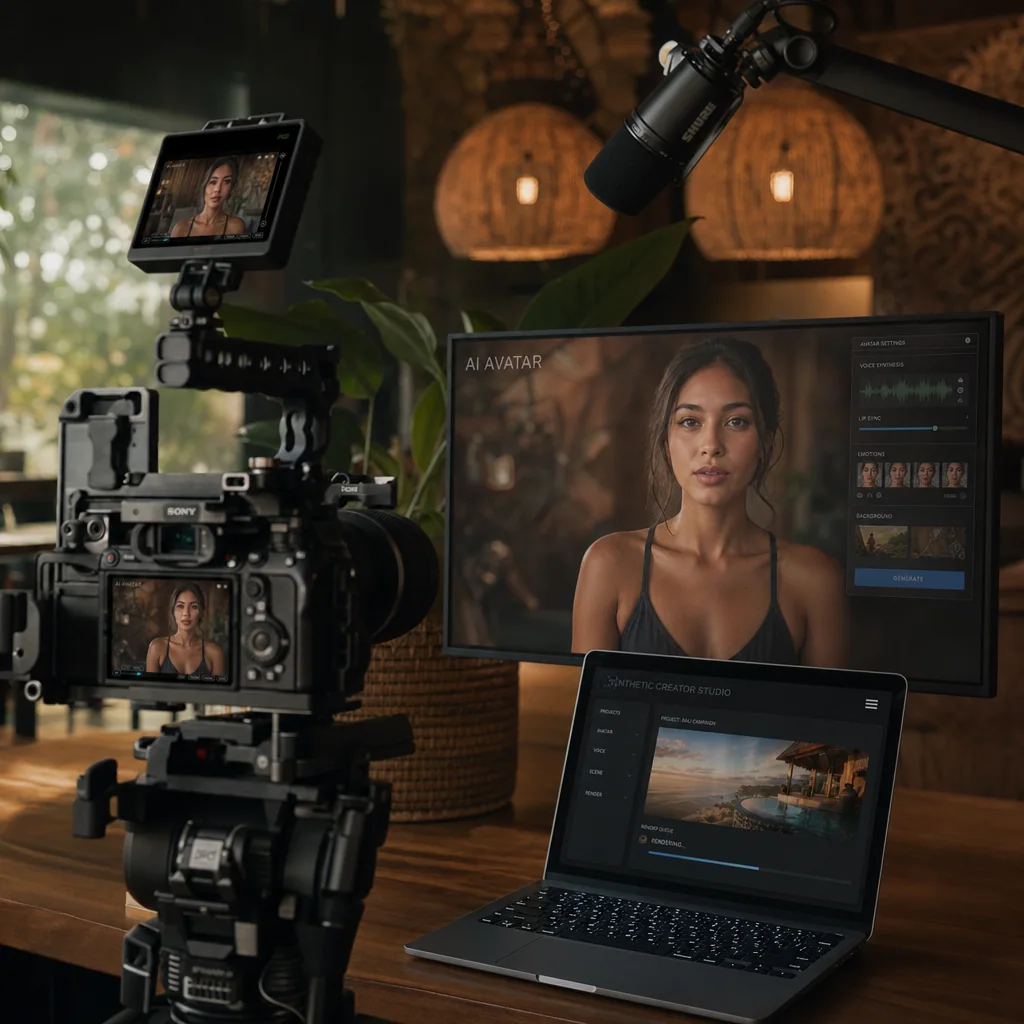
This is the model we run at Villo. Founders fly into Bali, film one session with Sony FX3 cameras, Aputure 600D lighting, and Shure SM7B audio — the same kit we use for talking-head shoots — and leave with training data clean enough to feed a high-fidelity avatar model. Here’s how Villo Studio trains custom AI avatars on real founder footage.
One note worth making: the same training session in Los Angeles or London runs at 3–4× our studio rate. The avatar model output is identical. The production cost is not.
Stock Avatar vs. Custom AI Avatar: What Learners Actually Notice
Pull up a stock Synthesia avatar next to a custom-trained one. The differences land fast — not where you’d expect.
Learners notice audio first. Flat emphasis, unnatural pause length, robotic prosody — these break the spell faster than a slightly stiff face. Custom avatars trained on real vocal range hold up dramatically better because the model has hours of your actual speech to draw cadence from.
Second is micro-movement. Stock avatars blink on a metronome. Real humans don’t. A custom avatar trained on varied studio footage inherits your blink patterns, your head tilt when you emphasise a word, the way your eyebrows move between ideas.
Third is script naturalness — and that one’s on you. Even a perfect avatar reading robotic copy sounds robotic. Write the script the way you talk.
HeyGen, Synthesia, and D-ID all support custom avatar training. Quality differences between platforms are real but secondary to a more fundamental input: the footage you train on. A custom avatar trained on a bedroom webcam looks like a custom avatar trained on a bedroom webcam. The same person filmed with controlled lighting, three-camera coverage, and broadcast audio produces a model that holds up at full course length.
The avatar is only as good as the footage it was trained on. That’s the whole pitch.
A Practical Fit Checklist: Should Your Course Use an AI Avatar?
Run your course through these five questions before spending a dollar on an avatar subscription or a training session.
| # | Question | If YES | If NO |
|---|---|---|---|
| 1 | Is the core value information, not your presence? | AI avatar can work | Stay on camera |
| 2 | Will you produce 10+ videos where consistency matters? | AI avatar saves time | ROI unclear at low volume |
| 3 | Do you need multilingual versions? | Strong avatar use case | Less relevant |
| 4 | Is your price point above $500 and trust-dependent? | Custom avatar minimum | Stock avatar risky |
| 5 | Are you willing to disclose AI use to your audience? | Proceed with confidence | Reconsider entirely |
Three or more YES answers — with question 1 as a YES — means an avatar workflow will likely pay off. A NO on question 1 overrides everything else. No avatar saves a course that’s really selling the founder.
Frequently Asked Questions About AI Avatar Videos for Courses
Are AI avatar videos effective for online courses?
They work well for structured, information-dense content — tutorials, explainers, compliance modules. They underperform in high-trust, coaching-style courses where learner connection to the instructor drives completion and retention.
What is the best AI avatar tool for course creators?
Synthesia and HeyGen are the two most-used platforms. Synthesia leans enterprise and eLearning. HeyGen is popular with independent creators for realistic lip-sync and custom avatar quality. D-ID is a third option worth comparing before you commit to a subscription.
Do students know when a course uses an AI avatar?
Increasingly, yes — especially with lower-tier stock avatars. Some learners report feeling deceived when avatar use isn’t disclosed upfront. Transparency is the safer move, particularly in premium-priced programs where refund disputes are already climbing.
Can I use my own face as an AI avatar for my course?
Yes. Platforms like HeyGen and Synthesia let you train a custom avatar on your own likeness, which performs noticeably better for learner trust than stock avatars. Quality depends almost entirely on the training footage — controlled lighting and broadcast audio over a webcam recording. Here’s our AI avatar production process at Villo.
What types of online courses should NOT use AI avatars?
High-ticket coaching programs, wellness or therapy-adjacent courses, and any course where the instructor’s personal story is the core value proposition. If your sales page sells you, your videos need to deliver you.
Is it ethical to use an AI avatar in an online course without disclosing it?
Actively debated. Most legal frameworks don’t yet require disclosure, but audience trust norms have moved faster than the law. In premium courses, undisclosed avatar use is already generating refund disputes. Disclose, and the issue disappears.
Ready to Film Your Custom Avatar Training Session?
If your course passes the checklist and you’re heading toward a custom avatar workflow, the training shoot is the decision that determines everything downstream. Bad input footage produces a bad model — one you’ll live with for the next two years until you re-film.
We run dedicated custom avatar sessions at our Canggu studio: 4 to 6 hours of varied delivery, three-camera coverage, Shure SM7B broadcast audio, Aputure 600D lighting tuned for model training rather than YouTube. One session, one founder, one model that holds up across hundreds of course videos.
See the full AI avatar production process and book a session →