

US digital video ad spend is projected to pass $80 billion in 2026. IAB (2026) puts it at about $81.9 billion, up 11% year over year. Most advertising video guides that rank today come from video software vendors, so they teach you to build the ad yourself in a template. This guide covers the other half: what sets the price of a professional shoot, who does what on the day, and what to ask a studio before you book.
We write from the studio side. Villo Studio shoots from Pererenan, Canggu. Some of our clients use the footage from their sessions as ads, usually on their own website or on YouTube.
What an advertising video is and which formats one shoot should cover
An advertising video is a short, paid-for video that promotes a product or service. A YouTube pre-roll, a sponsored Instagram Reel and a 15-second spot on a smart TV app all count. They share a media budget and differ in length and shape.
One well-planned shoot day can feed four placements. In-stream ads play inside other video, such as YouTube pre-roll. Feed ads sit in Facebook, Instagram and LinkedIn timelines. Short vertical ads run on TikTok, Reels and Shorts. Connected TV (CTV) ads play on smart TVs and streaming apps. Each placement wants its own aspect ratio and length, so list them in the brief. A missing vertical crop can't be fixed in the edit.
Creator-style content is the fastest-growing part of the budget. US creator ad spend was $13.9 billion in 2021 and $29.5 billion in 2024. IAB (2025) projected $37 billion for 2025 and about $44 billion for 2026. The same report found that 48% of creator ad buyers call creators a "must buy" channel, just behind paid search and social media.
Paid amplification means ad money put behind content that first ran as an organic post. It changes how you shoot. IAB (2025) expects about $13.2 billion of 2026 US creator spend to come from it, up 48%. So shoot footage that works as a normal post and still holds up as an ad. That means clean sound, a clear opening line and a call to action you can cut in or out.
These figures are US data, not Bali data, and no comparable public numbers exist for Indonesia. They still matter, because the same ad platforms serve buyers in every market. Wyzowl's video marketing survey found that 91% of businesses use video as a marketing tool and 92% plan to keep or raise their video budget. The survey had only 266 respondents, so treat the percentages as a rough guide.
How long an advertising video should be, and how to open it
An advertising video works best at 30 seconds to 2 minutes, with the key message in the first few seconds. In Wyzowl's survey, 71% of respondents named that range as most effective, though the sample was small. The platform sets the final length. A 6-second YouTube bumper, a 15-second Reel and a longer landing-page video follow different rules. Shoot one longer master and cut the shorter versions from it.
The hook is the first few seconds, the part that makes people keep watching. Open with the problem, the result or a clear question, not a logo. In a spoken-to-camera ad, the hook is the speaker's first sentence. Write three versions and record all three on the day. Picking the best one in the edit costs nothing. Reshooting it costs a full session.
Each advertising video needs one goal, because the goal decides what you measure. Awareness, clicks and sales need different cuts and calls to action. Use the numbers to find the weak part:
- Viewers drop off early: the opening is weak. Rework the hook first.
- People watch but rarely click: the call to action is weak or comes too late.
- Clicks come in but sales do not: the message or the audience is wrong, not the video.
Marketers say this kind of measuring pays off. In Wyzowl's survey, 82% of video marketers reported good ROI and 88% said video helped them increase sales and leads. These are self-reported figures from a small sample, not a promise for any single ad. They do show why fixing the right part beats reshooting from scratch.
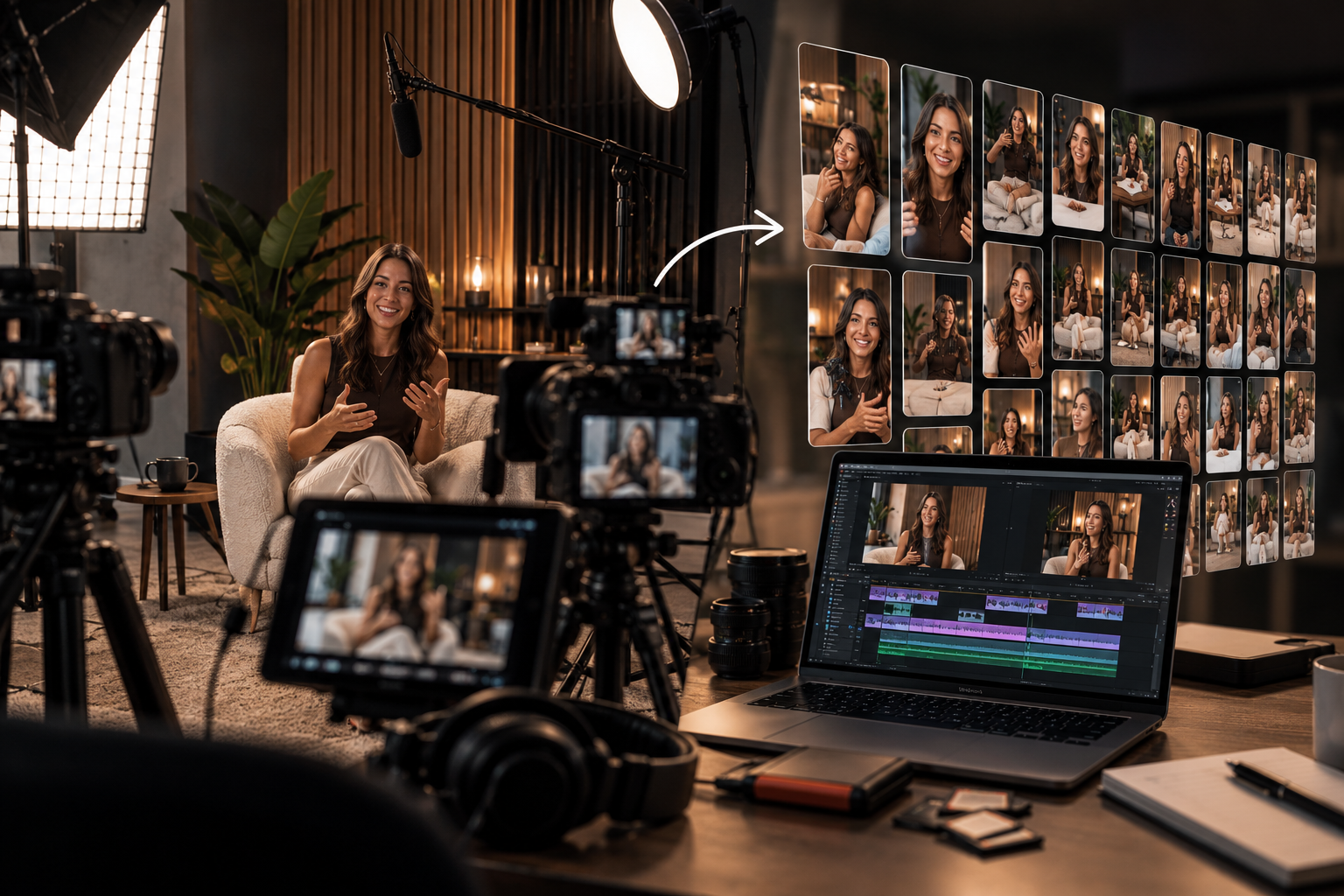
Put the cutting plan in the brief, not the edit. At Villo Studio the number of cuts, their lengths and their formats are not a fixed package: we agree them with each client. Whatever you choose, it only works if the operator frames for every crop you need and the speaker leaves clean pauses between sections. Our guide to short-form video editing explains how one session becomes a set of platform-ready cuts.
When a studio beats making it yourself, and when it does not
You can make an advertising video yourself when it is built from text, stock footage or simple product slides. Canva, Biteable and Descript-style editors handle these well. For a sale announcement, a product carousel or a quick test of three headlines, a template is the sensible choice. A studio budget would be wasted there.
A studio or crew wins when the ad shows real people or a real place. Templates can't fix a face lit by a window behind it, light that changes halfway through filming, or a founder who loses their place on take four. A crew also keeps five or ten ads looking the same, because the lighting and framing repeat. If your ad depends on a face earning trust, pay for the people who control the light and the frame.
Cost is why some businesses skip advertising video entirely. Wyzowl's survey found that among businesses not using video, 24% name cost as a top reason, tied with "not needed". A shoot saves money when one session produces several cuts and the cost per ad drops. It wastes money when the brief is unclear and the day ends with one usable take.
A failed DIY advertising video often costs more than a booked session. You pay for hours of filming, get unusable footage, then pay for the second attempt anyway. Our breakdown of what video retakes really cost shows where that money goes.
Villo Studio fits when your advertising video needs a person on camera and a consistent look across a series. For everything else, start with a template. Come to a studio when the template stops being enough.
What drives on-site video production rates
On-site video production rates depend on what the shoot must deliver. We searched for a firm Bali rate card while preparing this guide and found none. Marketplace and freelancer listings showed a wide spread that nobody could verify. Treat any single number you see online as a guess until it comes with a written scope.
Eight drivers set the price. Each adds shoot time or edit time:
- Shoot time: a short session, a half day, a full day or several days.
- Locations: every move between places costs setup time.
- Crew size: one operator, or a larger team.
- Talent and spoken lines: a founder reading a script needs more takes than silent product shots.
- Gear: number of cameras, lighting and sound equipment.
- Deliverables: how many cuts, in which lengths and aspect ratios.
- Edit rounds: each round of changes is editing time.
- Music and usage rights: licensed music and paid ad use can carry their own fees.
Shoot time, locations and crew size set the on-site cost. Cuts, aspect ratios and revision rounds set the edit cost. One session that produces five cuts costs more than one that produces a single cut, but the cost per advertising video drops sharply. That is the main lever a small business controls.
Here are Villo Studio's base rates:
- Studio session: IDR 3,000,000, with a minimum of 1 hour.
- On-location session at your villa, office or event: IDR 4,000,000, with a minimum of 2 hours.
- Partner studio: if the shoot takes place in a partner studio, an extra studio fee of IDR 600,000 applies.
The final quote depends on what you need delivered, so send your brief first. Our breakdown of what a video studio costs in Bali lists more studio-side numbers.
A cost-driver checklist to copy into your quote request
Compare written quotes built on the same one-page brief, not day rates from different studios. Copy these lines into your message and fill them in. Every studio, Villo Studio included, can then price the same ad:
- Goal of the video (one goal) and where it will run.
- Shoot length (hours or days) and preferred dates.
- Number of locations, their addresses, a map pin and photos of each space.
- Who appears on camera, and whether they speak.
- Script status: ready, draft, or needs writing.
- Cuts needed: lengths and aspect ratios (16:9, 9:16, 1:1, 4:5).
- Number of edit rounds included.
- Music: licensed track, stock track or none.
- Who approves the cut, and how fast.
If a quote comes in higher than you planned, cut deliverables before you cut crew.
How an on-site shoot runs from brief to edit
Villo Studio runs an on-site advertising video shoot in five steps. Each step locks in decisions for the next:
- Brief and script. You set the goal, audience, placements and cuts. The script follows from the brief, and the shot list follows from the script.
- Location photos and map. We usually don't visit the location in advance. Instead, you send a map pin and photos of the space, so we can judge the room, the window light and where to set up.
- Shoot day. Our operator comes to the location, sets up the camera and, when the situation needs it, lights. Then we record the script, the hook variants and the extra shots the edit needs.
- Edit. After the shoot, the footage goes back to our studio, where we edit it.
- Delivery. You receive the agreed cuts, in the lengths and aspect ratios you listed in the brief.
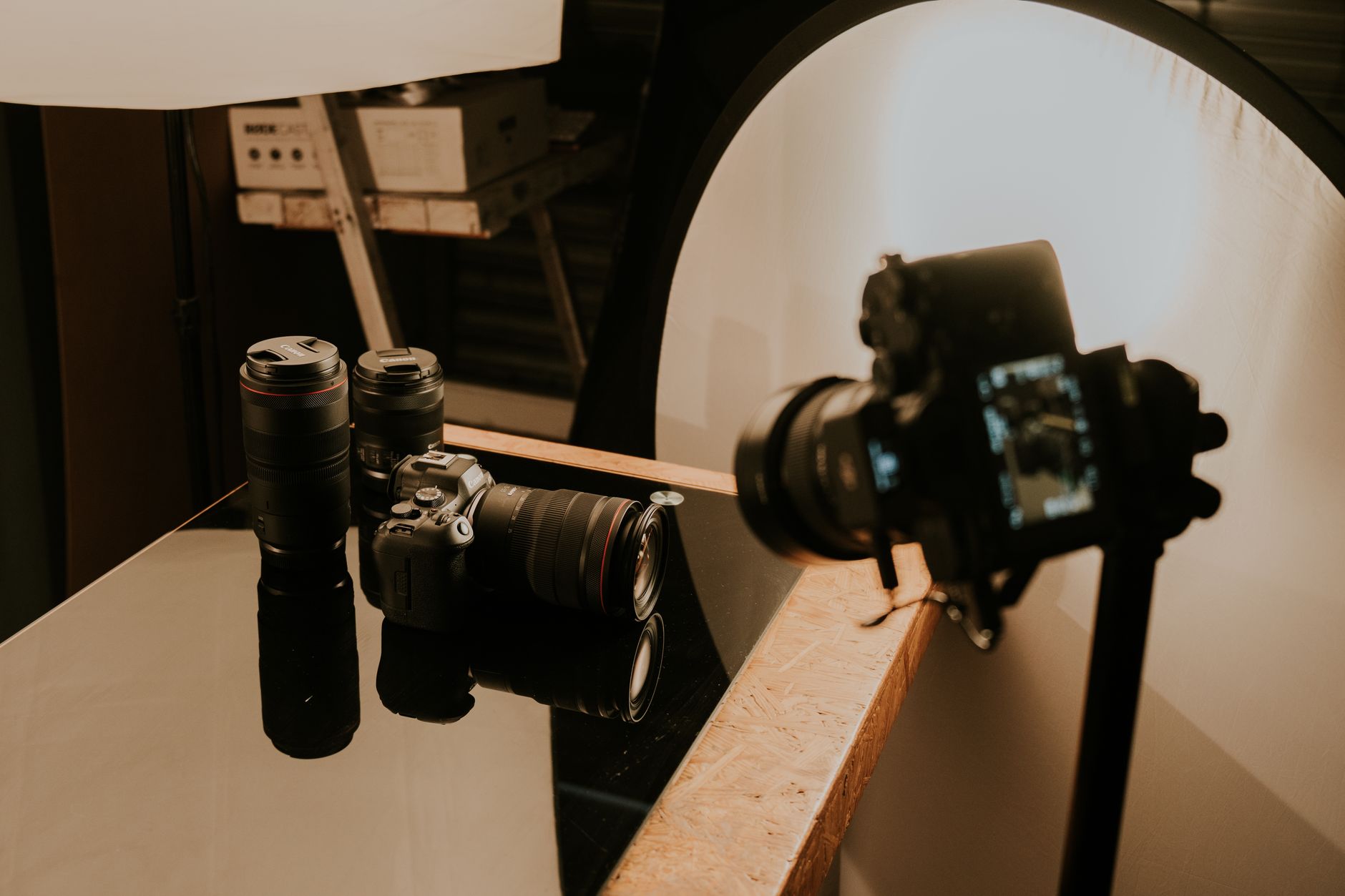
For a typical on-site session we bring one camera. Lights are optional and depend on the location. For portrait-style sessions we don't bring a microphone, so if your ad relies on recorded speech, say so in the brief and agree on how sound will be handled. The crew is at least one person, usually two, and we adjust it to the job. Ask any studio you compare exactly what gear and how many people come to the shoot.
Audio and light are the two things most likely to go wrong on location. Light is hardest when filming runs through a big change in daylight, such as the shift from afternoon to evening: shots taken an hour apart stop matching. Pick a shooting time with steady light, and keep the photos you send us true to that time of day.
On-site interview videos need a specific setup. The interviewer sits off camera, and the room is often not made for filming. The room's layout is crucial: the position of the window, the noise level of the air conditioning, and the place for the camera. Before the shoot, we rely on the location photos you provide to plan these details. Our on-site interview video production guide details the setup process from start to finish.
Villo Studio's on-site shooting service handles the entire process from initial brief to final edits at your home, office, or event in Bali. Include the provided checklist with your inquiry for a quote that meets your requirements.
Six mistakes that waste a shoot day
Many poorly planned video ad productions run into issues even before filming begins. Each of the following errors is inexpensive to address at the outset but becomes significantly more costly to correct after the shoot.
1. No single goal for the advertising video
An advertisement that aims to sell, explain, and entertain fails at all three. The script becomes overly lengthy, the video runs on for too long, and the call to action is obscured. Focus on a single action you wish the viewer to take, and remove everything that does not support it.
2. A weak or missing hook in the first seconds
If an ad begins with a logo or a gradual fade-in, many viewers will abandon it before the main content starts. Write three opening lines, record all three on the same day and select the most compelling one for use.
3. Script written after the shoot, or changed on the day
Filming with an unfinished script frequently leads to additional shooting days. Altering lines on location consumes paid time and may shake the performer's confidence. Ensure the script is finalized and approved in writing at least two days before the shoot. Our guide to video script writing services details what makes a script complete.
4. No plan for platform formats
An ad video shot for horizontal screens looks wrong if cropped vertically: the subject's face might be cut off or the product could go out of frame. Specify all relevant aspect ratios in the brief so the operator frames wide enough from the outset for a 9:16 vertical crop.
5. Poor sound and light at the location
Adjusting the light in editing software helps, yet it fails to remove echoes or the sound of passing scooters. Moreover, it cannot match shots taken in the afternoon with those taken in the evening. Before the shoot, inspect the room with doors and windows closed, noting where natural light falls at the intended filming time. Send location photos taken at that specific time.
6. No approver on the day
When the crew on set cannot decide, and feedback arrives after the edit from three different people, each round of changes costs more time and money. Name one person who gives the final approval for the cut. Their sign-off ends the project.
FAQ
What is an advertising video?
An advertising video is a short, paid video that promotes a product or service. It runs in four main places: in-stream, in social media feeds, as a short vertical video, and on connected TV. Each placement needs its own length and aspect ratio.
How do you make an advertising video?
You follow five steps: brief and script, location photos and map, shoot day, edit, and delivery of the agreed cuts. Use a template when the ad is made of text or stock footage. Bring in a professional crew for scenes with real people or real locations.
How much does advertising video cost?
The price varies with the scope of the project. At Villo Studio, a studio session is IDR 3,000,000 (minimum 1 hour), and an on-location session is IDR 4,000,000 (minimum 2 hours). If a partner studio is used, an extra studio fee of IDR 600,000 applies. The final quote depends on locations, talent, number of cuts, edit rounds and music licensing, so send a one-page brief.
How long should an advertising video be?
Most ads work best at 30 seconds to 2 minutes, with the key message in the first few seconds. In Wyzowl's survey, 71% of respondents named that range as most effective, though the sample was small. Shoot one master version and cut shorter versions from it.
Do you need a studio, or can you make it yourself?
If the ad is made of text, stock footage or product slides, you can make it yourself with tools like Canva and Biteable. For ads that need real people on camera, a specific location, or a consistent look across several ads, book a studio session.
Book your advertising video shoot in Bali
Fill out the nine-point checklist above and send it through our on-site shooting service page. Once we receive it, Villo Studio will send a detailed quote for your advertising video, covering the crew, equipment, shooting time and the cuts needed for each platform.