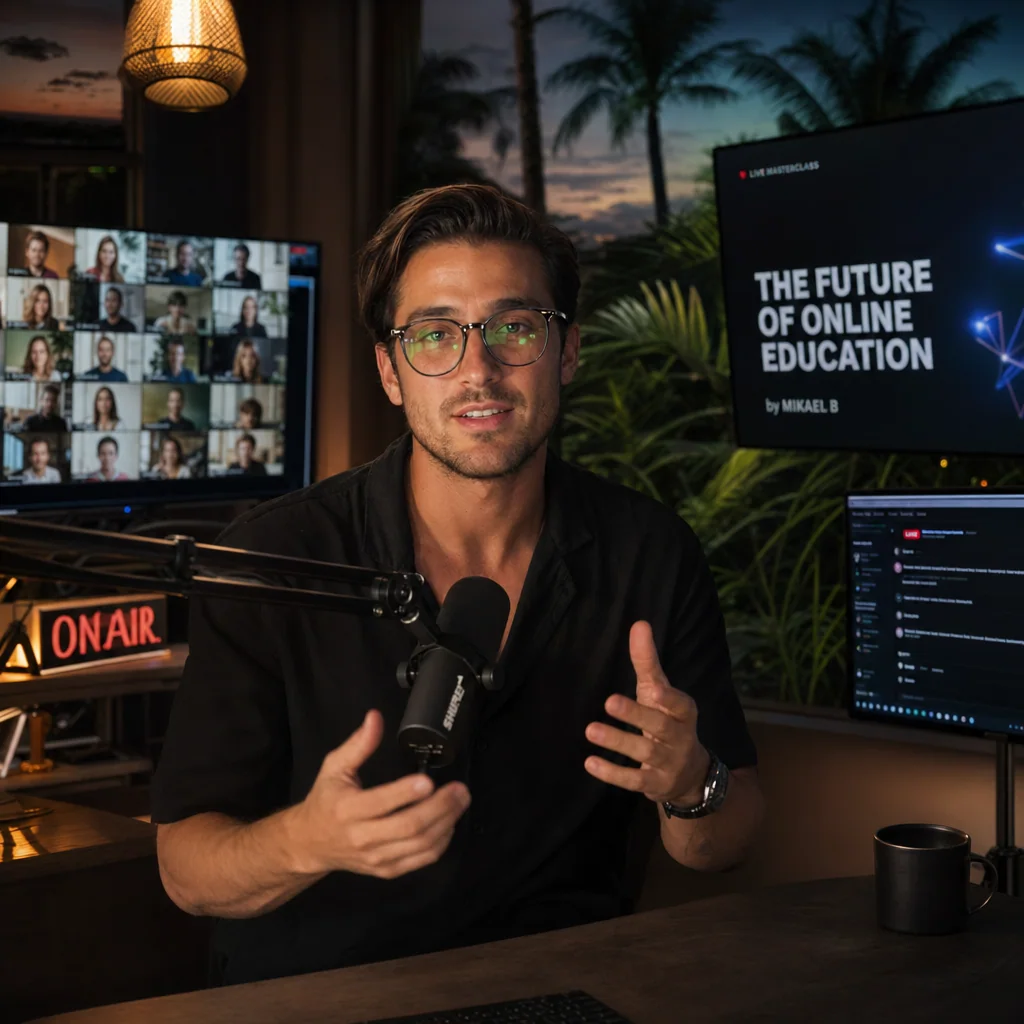


You’re in Bali. It’s 11 PM. The gecko’s on the wall, a warm breeze cuts through the studio door — and 400 marketing executives in Frankfurt are waiting for you to go live. This is not a compromise. This is the new standard for global webinar production.
For the past eighteen months, we’ve run live broadcasts from Canggu to audiences in Moscow, Berlin, London, and New York. The feedback is consistent: production quality matches any studio in a Tier-1 capital. The cost doesn’t. And the schedule flexibility — thanks to a time zone that ignores Western office hours — changes what a webinar can do for a business.
Why the Global Webinar Market Demands Better Production
The webinar market was valued at $800 million in 2019. By 2025 it’s projected to hit $4.44 billion, growing at roughly 20% CAGR (Grand View Research). That’s not slow cultural adoption — that’s a land grab.
When a format grows that fast, production quality stops being a bonus. It becomes the line between a brand that commands attention and one that gets muted in tab seven. Three years ago, a Zoom call with decent audio was enough. Today, an executive audience in Frankfurt compares your webinar to a Bloomberg broadcast, not their last internal meeting.
So the question isn’t whether to invest in production. It’s where to produce — and who can deliver broadcast quality without a six-figure studio bill.
Why Bali Is a Legitimate Broadcast Origin Point
The first objection from European CMOs: “Can you actually stream from Indonesia without it falling apart?” Fair question. Also outdated by five years.
Indonesia’s internet penetration reached 77% in 2023 — over 210 million users (DataReportal / We Are Social). Bali has been a priority for fiber rollout. Our Canggu studio runs on a 1 Gbps symmetric fiber connection with a 4G LTE failover and a separate Starlink dish as third-layer redundancy. Over eighteen months of live broadcasts, we have logged zero dropped streams caused by connectivity.
There’s a second chapter: in 2022, the Indonesian Immigration Directorate General launched the Digital Nomad Visa (Second Home Visa), a policy signal that the country intends to host long-term remote professionals. That visa brought capital, demand, and competition among local ISPs, co-working operators, and studios. The result is a video production studio ecosystem in Canggu and Pererenan that rivals what you’d find in Lisbon or Medellín.
Bali is no longer a creative retreat. It’s a broadcast node.
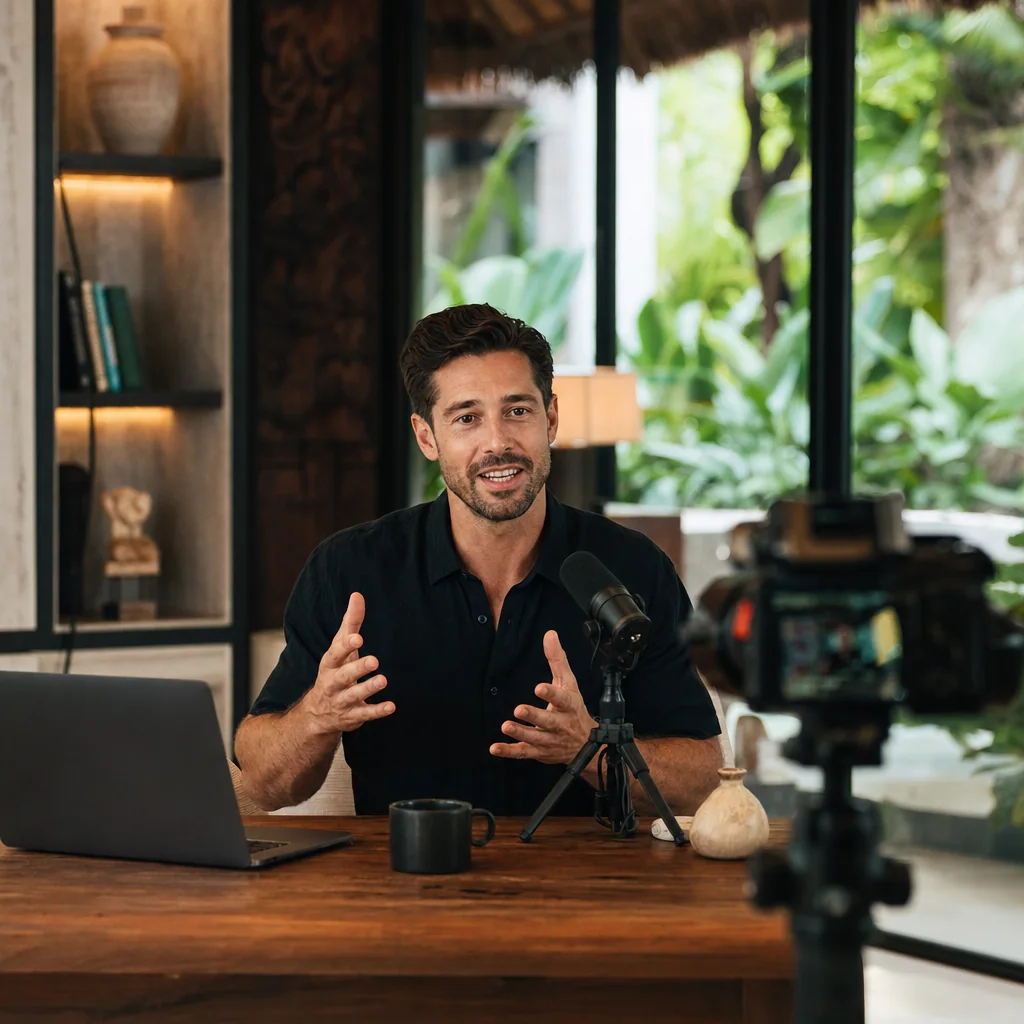
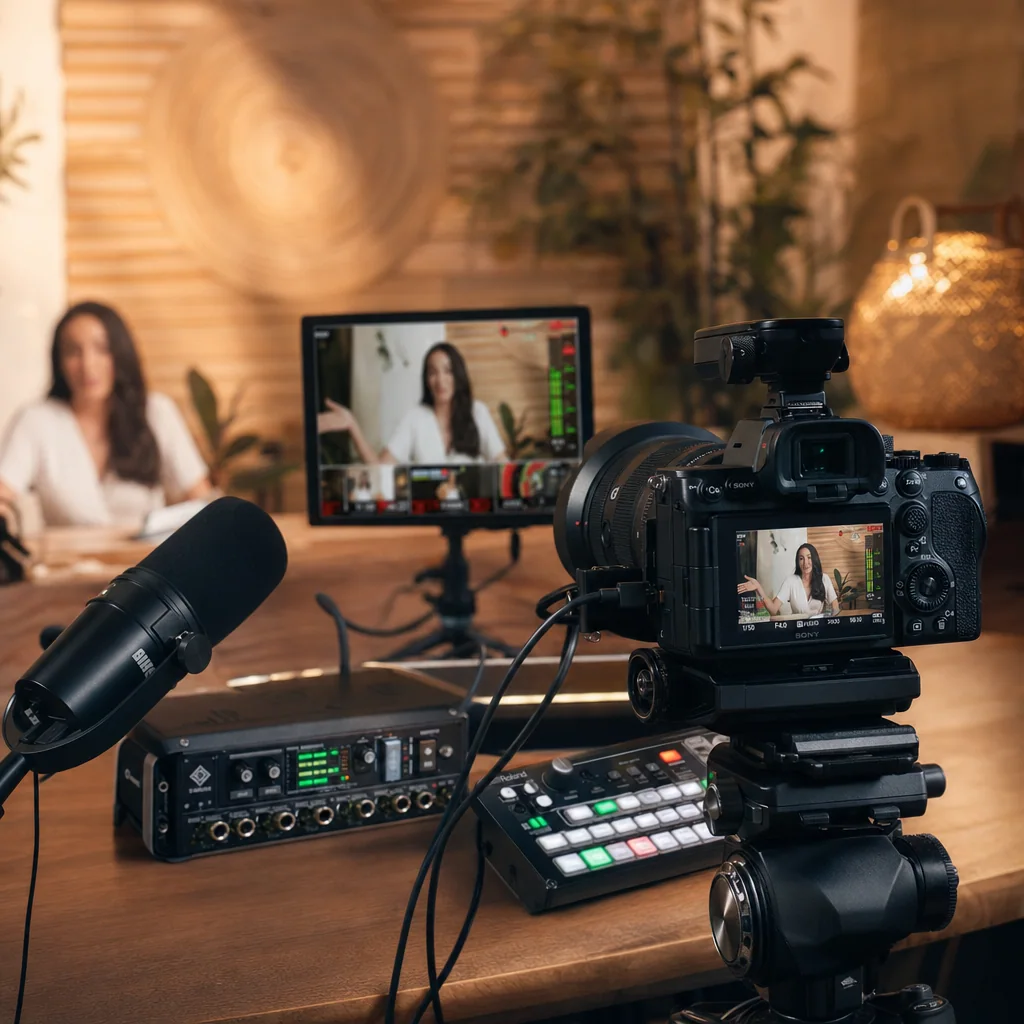
Production setup at Villo Studio for webinar production services
The Time Zone Advantage: Late-Night Slots That Serve CIS, EU & US
This is the part most studios can’t copy. Bali sits at UTC+8. Mapped against business-hour peaks in our three biggest client regions:
- 7:00 PM Bali = 2:00 PM Moscow, 1:00 PM Berlin, 12:00 PM London — prime midday for CIS and EU B2B audiences
- 9:00 PM Bali = 4:00 PM Moscow, 3:00 PM Berlin, 9:00 AM New York — one webinar serves Europe and the US East Coast simultaneously
- 11:00 PM Bali = 11:00 AM New York, 8:00 AM San Francisco — full US coverage at peak attention
- 1:00 AM Bali = 1:00 PM New York, 10:00 AM Los Angeles — coast-to-coast US reach
A host in London reaching Los Angeles at 9 AM local broadcasts at 5 PM UK time — doable, but fatiguing and expensive against UK studio rates. A Villo host running the same slot at midnight gets full crew support, a fresh broadcast environment, and studio live streaming packages priced at a fraction of London rates.
We book roughly 40% of our webinar slots between 8 PM and 2 AM local. Dead air for most studios elsewhere. Prime inventory for us.
What Pro-Grade Actually Means in a Live Streaming Studio
“Professional” has lost meaning. Here’s the hardware instead.
The Villo live streaming studio in Bali runs three cameras — two Sony FX3 units on main and host angles, one Sony A7S III on a wide safety shot. Switching happens on a Blackmagic ATEM Mini Extreme, which handles picture-in-picture for remote guests via Skype TX or StreamYard. Audio is captured on Shure SM7B microphones into a Rodecaster Pro II, mixed to broadcast-standard -16 LUFS stereo.
Lighting is a four-point setup: Aputure 600D Pro as key, Aputure MC Pro panels for accent and backlight, Godox SL60W on the backdrop. Skin tone reads consistent across Zoom, YouTube Live, LinkedIn Live, and Vimeo — regardless of platform.
Software stack: vMix Pro for the main broadcast, OBS Studio as backup encoder, a dedicated producer watching vitals on a second monitor. If the primary connection falters, failover to LTE happens in under four seconds. We know, because we’ve tested it on every live session since April 2024.
Standard crew: one livestream producer, one camera operator, one audio engineer. Events over 500 registrants add a second producer for chat moderation and Q&A curation. You show up, you speak, the rest works.
How Webinar Production Converts Registrants Into Revenue
Production is not vanity. It correlates directly with pipeline.
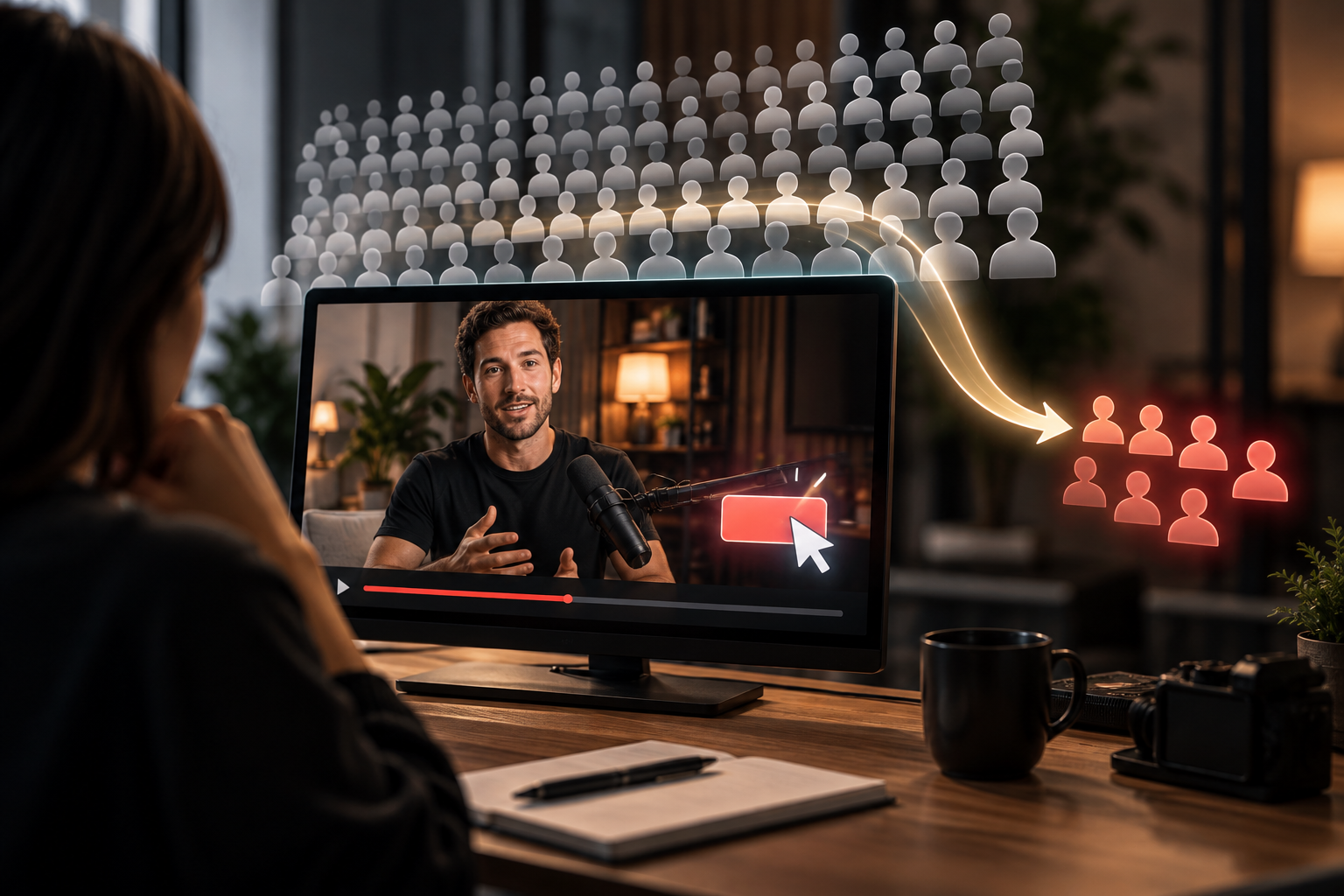
The ON24 Webinar Benchmarks Report pegs average registration-to-attendance conversion at 55%, with on-demand replays adding up to 30% more views. The Demand Gen Report found the average webinar generates 500–1,000 leads per event, and 73% of B2B marketers call webinars their best channel for high-quality lead generation.
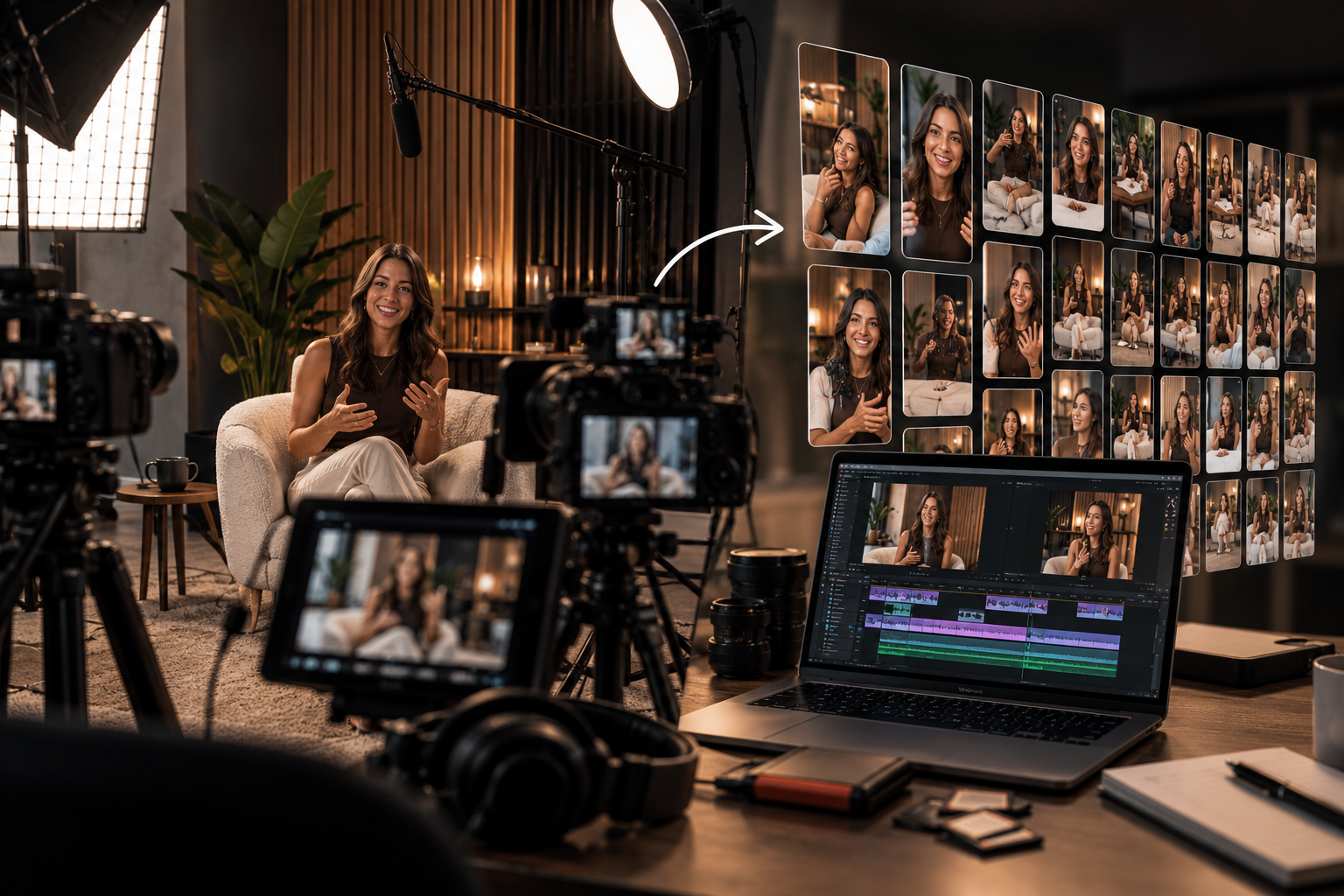
Three mechanics drive results above that baseline. First, retention: clean audio and sharp video reduce drop-off at the 15-minute mark — attendees stay long enough to hear the offer. Second, perceived authority: executive audiences assign credibility to brands that look like broadcast operations, which lifts average deal size. Third, replay value: a well-produced recording clips into LinkedIn posts, YouTube Shorts, and email nurture sequences for six months. One webinar becomes thirty content assets.
In November 2024, a SaaS client ran a 90-minute webinar from our Canggu studio: 847 registrants, 61% attendance, 23 demos booked within 72 hours, 4 contracts closed within 60 days. The replay — cut into 11 LinkedIn clips — generated another 14 inbound enquiries the following quarter.
That’s why production quality pays for itself on the first broadcast.
What to Expect When You Book at Villo Studio
Week before the event
We run a 45-minute tech call with your marketing ops lead. We test the streaming destination (Zoom, YouTube Live, LinkedIn Live, custom RTMP), confirm slide format and aspect ratio, and align on graphics: lower thirds, title cards, outro slate. Remote guests receive a calibration link 48 hours ahead to check camera, microphone, and bandwidth.
Day of the event
You arrive 90 minutes before go-live: wardrobe check, mic fitting, rehearsal of the first three minutes and the Q&A transition. Fifteen minutes out, the producer runs a final stream test and confirms the count-in. For the next 60 to 120 minutes, the crew handles camera switching, audio mixing, slide advance cues, remote guest connections, and live chat moderation.
48 hours after the event
You receive the full recording in 4K, a broadcast-ready master in 1080p, a 60–90 second highlight reel, and three 30-second vertical clips for LinkedIn and Instagram. Replay add-ons — transcription, captions in multiple languages, chaptered YouTube version — are available as an editing upsell.
Our webinar production services are priced per session, not per hour. Most clients book recurring monthly slots.
5 Moves to Maximize Your Global Webinar ROI
1. Promote in your audience’s time zone, not yours
If 70% of registrants are in Berlin, every email and LinkedIn post should show “3:00 PM CET” — not “9:00 PM Bali time.” Tools like Savvy Cal auto-convert for each viewer. Registration rates climb 15–25% when the time-zone math disappears.
2. Caption for multilingual reach
Roughly 40% of LinkedIn users watch video on mute. Order transcription the day of the broadcast, translate to your top two secondary markets — Russian and German, in most of our clients’ cases — and upload subtitle files to the replay platform. This alone can double replay watch-time.
3. Clip the replay within 72 hours
Cut five to seven 60-second clips from the most quotable moments and publish them on LinkedIn across the two weeks following the event. Each clip drives traffic back to the gated full replay. One webinar becomes a month of organic reach.
4. Gate the replay, not the live
Make live attendance frictionless. Put the replay behind a short form — email, company, role, nothing more. More live attendees up front, a steady drip of replay leads for the next six months.
5. A/B test one CTA slide
Run the same webinar twice, one month apart, with two different closing CTAs. One client discovered their “book a demo” CTA converted 2.3x better than the asset-download they’d used for three years. Most brands find their assumed-best CTA isn’t.
Ready to broadcast?
Late-night slots for Q1 are filling now. We run two webinars per week during peak season and keep a hard cap on bookings so every client gets a dedicated producer.
Review the full spec and pricing on our webinar production services page, then message us with your preferred date and target audience region. We’ll confirm availability within 24 hours and send a tech-prep checklist the same week.
Your audience in Frankfurt, New York, or Moscow doesn’t care where the signal originates. They care whether the broadcast is worth their hour. That part, we handle.