

Home / The growth of the mobile gaming industry in Indonesia
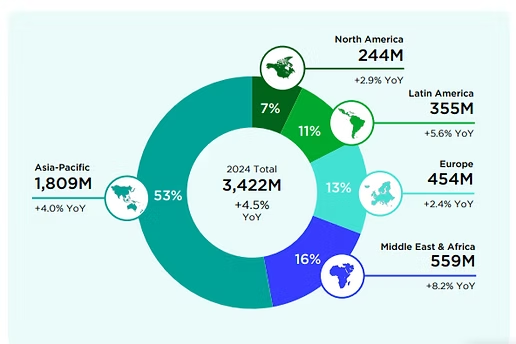
The mobile gaming industry is expanding rapidly across the globe, and nowhere is this growth more visible than in the Asia-Pacific region. Indonesia has emerged as one of the leading mobile gaming markets in Southeast Asia, driven by a combination of affordable technology, expanding internet infrastructure, strong government backing, and a young, digitally native population. According to an analysis by Sensor Tower, mobile game downloads in Indonesia grew by 10% between January and August 2024 alone — a figure that signals not just momentum, but a fundamental shift in how Indonesians consume entertainment.
Indonesia is a country in the Asia-Pacific region with a population of approximately 270 million people, making it one of the most significant digital markets in the world. The Asia-Pacific region as a whole currently accounts for 53% of all gamers worldwide. According to NEWZOO, the total number of mobile gamers globally reached 2.848 billion in 2024, with 1.809 billion of those players located in Central and Southeast Asia alone.
These numbers reflect the sheer scale of the opportunity in this part of the world. Indonesia specifically ranked fourth in the NEWZOO Global Gamer Study, and additional research from the Statista Research Department published in February 2025 confirms that Indonesia’s mobile gaming market currently has 76.92 million active users — a figure that continues to grow year on year.
These figures clearly illustrate the extraordinary popularity of mobile gaming in Indonesia and naturally raise the question: what are the key factors driving this growth?
Indonesia is a modern and technologically progressive nation where digital adoption is happening at remarkable speed. Smartphones have become an inseparable part of everyday life, functioning simultaneously as a personal assistant, communication tool, and primary source of entertainment for millions of people across the archipelago.
The high penetration of smartphones in Indonesia is driven largely by competitive pricing and the wide availability of devices from Asian brands. Oppo, Xiaomi, Realme, and Vivo dominate the market and offer a broad spectrum of price points — ranging from approximately 1,460,700 to 6,492,000 Indonesian Rupiah. This makes mobile devices accessible to the majority of the population, including users in smaller cities and rural areas.
By comparison, the average price of a desktop PC in Indonesia sits at around 21,060,200 Rupiah, while gaming consoles start at approximately 1,700,800 Rupiah. Even at the lower end, consoles remain significantly more expensive than entry-level smartphones. This price gap is a decisive factor: for a large portion of Indonesian consumers, mobile gaming is not just a preference — it is simply the most practical and affordable way to game.
Indonesia’s internet infrastructure has developed rapidly and now ranks the country among the world’s leaders in terms of total internet users. As of February 2025, Indonesia holds fourth place globally in digital population — a ranking that reflects both the country’s scale and the speed of its digital transformation over the past decade.
The growth in mobile game downloads is directly supported by several key connectivity factors:
Together, these factors create the ideal environment for mobile gaming to thrive — fast connections, wide coverage, and a population that is deeply comfortable with mobile-first digital experiences.
Indonesia’s mobile gaming growth has not happened by accident — it has been actively shaped by government policy at the highest level. The first significant steps came in 2018, when President Joko Widodo publicly acknowledged the enormous potential of the digital industry and positioned digitalization as a core driver of national economic growth.
Building on this foundation, 2024 saw the introduction of Presidential Decree No. 19, specifically designed to accelerate and strengthen Indonesia’s national gaming industry ecosystem. The decree outlines four primary areas of focus:
This level of institutional commitment signals that Indonesia views gaming not merely as entertainment, but as a strategic industry with significant economic and cultural value.
Perhaps the most powerful long-term driver of Indonesia’s mobile gaming growth is its demographic profile. Indonesia has one of the youngest populations in Southeast Asia, and its youth have embraced mobile gaming not just as a pastime, but as an integral part of their social identity and daily lifestyle.
According to research by Deloitte, the majority of active gamers in Indonesia belong to Generation Z — a cohort representing approximately 34 to 35 million people. For this generation, mobile gaming is deeply intertwined with self-expression, social interaction, and community belonging. Online multiplayer games in particular have become a primary social space, especially for young Indonesians living in urban environments where traditional communal spaces are increasingly being replaced by digital ones.
Beyond casual gaming, the rapid growth of esports in Indonesia is creating tangible new career pathways — from professional players and coaches to event organizers, streamers, and content creators. This professionalization of gaming is further legitimizing mobile gaming as a serious pursuit in the eyes of both young people and their families.
The key takeaways from Indonesia’s mobile gaming landscape are clear:
The mobile gaming industry is growing worldwide, and Indonesia is positioning itself to be at the center of that growth in Southeast Asia. The conditions — demographic, economic, technological, and political — are aligned in a way that makes the country’s trajectory in gaming genuinely exciting to watch.
If you are planning a gaming webinar, live stream, online tournament, or content production session in Indonesia, Villo Studio is here to support you. We provide a fully equipped space for streaming, video production, and podcasting — right in the heart of Bali.
👉 Visit our website or follow us on Instagram to learn more about what we offer.